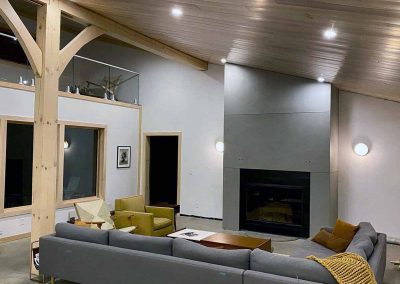
Concrete fireplace is the result of collaboration and creativity

One of our French-Canadian students, Eric D’Amours of Gatineau, Quebec, sent us some pictures of a great project he’d recently completed, and I talked with him to get the full scoop. It’s a great example of working with the client to achieve success.

Eric: The client for this project is my wife’s co-worker; she saw some pictures of work I had done previously and asked if I could do a fireplace mantel for her. She did not really have any idea of what she wanted.

I set up a meeting and showed her different colored samples. I had one that was from an integrated sink done with the pressed technique. She really liked it. After talking for a while, she thought she would want the base gray color a little lighter than the sample. As for the color in the veining, I suggested that we match the surrounding decor, and she thought that a dark brown was a wonderful idea.

Jeff: It’s always important that the customer is aware of what is possible, and that even though you might not have a sample immediately ready, that you can create a custom look that will fit their home. If Eric hadn’t communicated to the customer that he could design a color for her, she might not have accepted the offer. 

Eric: I went and templated the fireplace which gave me a good idea of what it would look like. On the existing fireplace there was a metal piece that was at an angle. I decided that I would make an angled piece also to put more punch to the look and also to better finish the fit from the mantel to the existing fireplace.

Jeff: Always work with what you’ve got whenever possible. If there’s a way to incorporate an existing bit of character, do it! The customer will be happy that you haven’t torn out more than you have to, and the end result will be unique.

Eric: The challenge was to have an even thickness of 1 inch all around in a pressed technique with a 3D piece  (and I want to take the 3D course at one point to help me with having more ideas and techniques for future projects). The little angled piece was also a challenge, mostly with making the mold, and finding a way to have finished edges all around that portion.

Jeff: Once you have a solid foundation in the basics, you can go a really long way. Extra training is never a bad thing, but don’t limit yourself just because you’ve never tried something before. Practice, experiment, and practice some more!

Eric: Definitely when you de-mold the piece it is the most exciting part. You are so anxious to see if what your mind has created will turn out like you thought it would.

I also wanted to see how the integrated logo in the piece  would look. What better advertisement to have your logo in the piece  (the client had agreed to this before).

Jeff: If the customer agrees, that’s a great way to put your stamp on a project. Word of mouth referrals are great.

In the end, the client was pleased, and the project turned out great. The client has a beautiful, functional piece of art that truly compliments her home.

Closeup of pattern and angle

 Eric attended The Ultimate Concrete Countertop Training in March 2012.


Concrete countertop professionals around the world

I was working on the November newsletter and thinking about the things I am thankful for, in preparation for the Thanksgiving holiday. One of those things is that I’m part of the exciting, growing concrete countertop industry that is rapidly expanding not just in the U.S. and Canada, but all over the world.

This inspired me to make a map of where all my students have come from. Here is the result. It’s amazing where this concrete countertop phenomenon has traveled!

Concrete countertop students around the world

CCI student map

Turning Play into Profits with Concrete Furniture

When you’ve got a busy concrete fabrication shop, it can be hard to find the time to create projects that no one has ordered. Yet that’s just what Lenny Cushing, a student from New Hampshire and owner of Zen Stoneworks, has done, and it’s paid off. He takes the time to save images, rough sketches, and architectural designs that he loves, and keeps a collection of them in his studio. These are what he draws on when he is inspired to create a new piece, whether it’s a customer-requested job or just something that he makes for the joy of it.

And rather than sticking with your typical countertop or vanity, Lenny embraces experimenting with entirely new things, is willing to take risks, and loves to see how far he can push his craftsmanship. He’s learned a valuable lesson: at some point, you just have to get out there, get your hands dirty, and see what you can do!

For the pieces pictured below, Lenny had to do a lot of experimentation with his molds and designs. The cantilevered bench was hard to calculate, because the pieces interlocked at angles. It was definitely challenging, but clearly worthwhile, as the project turned out beautifully. The more he tried to plan it out ahead of time, the more he realized how much had to be figured out as he went along (before casting, of course). Often a little trial & error in the initial stages of a project can save massive headaches once a piece has been cast!

Lenny and his crew are working with some experimental materials, trying new things which will allow for really interesting shapes and designs. He’s done his research and knows that there’s a huge market for artistry in furniture right now, and a design must be both beautiful AND functional. That which is pretty must still have a purpose.

We look forward to seeing what he’ll do next! You can check out more of his work here: www.zenstoneworks.com, or contact him at 603.319.8700.

Lenny attended CCI training in December 2009.

From Cars to Concrete – Creativity Isn’t Industry Specific

Nick has always been a creative type. In his words: “I spent years restoring and painting cars, trucks and motorcycles during high school and part of college. Combine that with years in construction and remodeling. That started out with woodworking, building homes and then starting out in the decorative concrete industry while attending CSU Fresno which led to traveling for a development company doing remodeling projects in Oregon, Colorado, Texas & California.” No small amount of experience there!

I caught up with Nick recently, and he told me about a job he just finished. The customer requested a concrete shower – three walls and shower basin, all made out of concrete, with a custom accent on the back wall. The existing shower enclosure was fiberglass, which had to be torn out; the entire thing had to be rebuilt from the studs up.

Nick was able to use fabric forming around an existing mold to get the shower basin. This was the most challenging part, because the basin had to be slanted enough to allow the water to drain, while being a stable surface to stand on, and the whole thing had to be kept to code. Using fabric forming was a great option, because it allowed for exact measurements while also keeping the aesthetic integrity of the shower intact.

Shower pan mold


Shower pan installed

The customer requested a golden brown color with a veined look, so the entire shower had to be hand-pressed with a lighter brown veining for contrast. It was a complicated piece, but very well worth the extra effort!

The finished shower


Closeup of the decorative accent

The customer was so thrilled she’s commissioned the rest of her bathroom to be done as well. Nick hopes to keep his hand in with unique projects, and has some great plans for marketing and winning commissions for his craftsmanship.

With Nick Shaffer of The Concrete Movement in Clovis, CA and Chico, CA
Phone: 559-355-3606
Website: www.theconcretemovement.com

Nick attended The Ultimate Concrete Countertop Training in October 2011.

Recent cool concrete countertop projects by students

Recently I’ve had several students send me photos of cool concrete countertop, bartop or sink projects they’ve been working on. Check these out!

Brent Gwynn of Pro Builders Construction in Rices Landing, PA


Brent attended the Ultimate Concrete Countertop Training class in March 2012, and just a few short weeks later, he was installing this concrete retail counter for a local beer store. Congrats Brent! I hope you get free beer as part of the deal. (Nice shop too! Very impressive organization.)

Ajaay Srinivaas of Nuance Studio in Bangalore, India


I visited Bangalore, India to train Ajaay in late March/early April 2012. Since then, he’s been flooded with orders for concrete sinks, or “washbasins” as he likes to call them. I’m so excited about the innovative designs he’s come up with, and the fine detail of the craftsmanship. Great job Ajaay! (See my article about the India trip here.)

Shorlette Francis of Creative Collections in Nassau, Bahamas


Shorlette attended precast and GFRC class in 2008 and has been plugging away ever since. As you can see, she has horrible working conditions. ;-) This concrete bartop incorporated classic Caribbean elements of shells and beach glass, and it looks fantastic. Shorlette, I will have to come down there and celebrate with you!

ERO Decorative Concrete Builds Creativity on a Solid Technical Foundation

Erik Oftebro, a native of Santa Barbara, CA, has always loved working with his hands. He has transitioned from training horses at the family ranch to structural concrete, and finally landed in the decorative concrete industry. His passion for making beautiful concrete started when he was doing a job for a Harley Davidson shop near Sacramento which called for decorative concrete, a method he had been unfamiliar with. Once he started, he couldn’t get enough! He was inspired to get his concrete contractor’s license and went into decorative work full time as ERO Decorative Concrete.

Eventually, he decided to expand into the realm of concrete countertops, an area which he had known about, but hadn’t had a lot of hands-on experience in. He came to the CCI Ultimate class in March of 2011 and never looked back.

Erik loves the innovative possibilities inherent with concrete, especially in Santa Barbara, where people are ready to embrace new ideas and are excited to try new ways of doing things. He loves opening people’s eyes to the fact that concrete isn’t just this gray stuff (although it’s amazing how many people do prefer the ‘raw’ gray look), but is ripe with potential. The key is in making good concrete first, pretty concrete second. Once you know the principle foundations for making quality work, you can tailor the actual project to whatever the customer wants.

He had a project recently where a family was moving into a new home and wanted a custom stair case and landing that would match their countertops. The spiral staircase had 11 treads that had to be cast individually, since each was slightly different from the others. One of the daughters in the family won a fight with cancer, and the family commemorated the occasion by adding names and hand prints to one of the stair treads. Details like that really make concrete projects stand out to the average home owner.  

The landing was the challenging bit, since it was four feet across, three feet wide, had an inch ledge on two sides, and was unsupported on another. It also had a curve that had to fit flush against the wooden flooring. Quite a challenge! Erik was able to work with Jeff Girard to make sure he was creating a beam that would support the weight without cracking.

Erik Oftebro stair landing

Staircase landing flush with wood floor


Erik Oftebro stair treads

11 stair treads, all different sizes

Another recent project came from a referral by the general contractor in charge of a remodel; Erik’s name was mentioned and the client looked him up via the CCI Find a Contractor Listing. The client had a stone wine cellar that had a travertine bar. She didn’t like the striated look of it, and had thought about getting the piece done in limestone, but it would not have fit in with the aged look of the rest of the space. Erik was able to make a few samples until he found one the customer loved. He created a slab with travertine as the inspiration, and installed it raw into the space. He was then able to custom match a stain that gave the piece the same patina of the rest of the room, combining new and existing features seamlessly. The client was thrilled with the result, and has since commissioned several more projects.

Erik says it’s very satisfying to be able to accept a client that a lot of contractors would walk away from. Whether it’s someone who wants stair treads that match their counters, a sandstone-looking BBQ surround, or a vanity that is created to match a favorite picture, it’s a never ending challenge. There will always be ways to think outside the box.

He is very thankful that he put the investment in to learn the basic principles of concrete from Jeff. He has never had a callback about a quality issue, and that is mainly thanks to Jeff’s solid technical teaching. He is able to take what he knows and use it to build whatever the customer wants, and to get it right the first time out. That confidence in his own skill has enabled him to take the basic tools he learned at CCI and turn them into a success story.

Golf shop concrete countertop makes a big impact

When the owners of a golf shop approached Tony Angell to create a concrete countertop for their store remodel, they originally wanted just a plain, black countertop. That would have been fine, but not much of a challenge for Tony and not much of a focal point for the store. Instead of just settling for an average project, Tony turned this into a showpiece for both him and the golf shop. Here’s how he did it.

The owners were friends of the family, and familiar with the quality of Tony’s work in his Hugo, Minnesota based company, North Metro Concrete and Countertops. When Tony suggested getting creative, they said, “Go for it. We trust you.” And Tony did. The finished countertop incorporates the store’s name, a green, a water hazard, a sand trap, two golf clubs in the traditional crossed pose, a golf ball, blades of grass and a tee.

The owners couldn’t have been more thrilled. “They were blown away”, says Tony. “They had no idea what I was going to do beyond the store name.”

Tony’s original concept was to incorporate the store’s name, and then add some green grass to represent a golf course. But when you have a golf course, you have to have water hazards and sand traps. And you can’t play golf without a club, ball and tee. So the design kept evolving and growing as Tony used his imagination.

impact golf tony angell 012

To create the intricate shapes in multiple colors, Tony used various techniques and careful planning:

  • While other areas were pre-formed with foam, to create the blades of grass, Tony first cast that area in solid black, then used a dremmel to etch the blades, then filled them in with green grout. impact golf tony angell clo
  • He filled in the white areas last so that other colors wouldn’t bleed into it during processing.
  • The letters had to be put in the form upside down and backward, so Tony triple-checked his layout to make sure he had not reversed a letter.
  • Tony designed the lettering on a computer, printed the letters out on paper, then stuck them to ½” foam and drew outlines on the foam. He cut the foam on a scroll saw and carefully smoothed the edges with a sander. (This is similar to the way I created the CCI monolith described in this article.)

All of this required probably three times more thought, planning and work than a plain black countertop, but the results are orders of magnitude more impactful. Now Tony has an amazing showpiece in a store trafficked by golf enthusiasts such as doctors and lawyers. He has some extremely happy clients who will enthusiastically recommend him, plus display his business cards and brochures on the counter.

Best of all, he got himself and his wife a set of custom golf clubs in the deal. I’m sure he’ll put them to good use, and he can even do some networking on the golf course.

impact golf 013

Tony attended The Ultimate Concrete Countertop Training in March 2011.

Relationship marketing pays off for Evolution Architectural Concrete

by Lane Mangum, VP Business Services, The Concrete Countertop Institute

Dave Magnano of Evolution Architectural Concrete in Essex, CT recently completed a nice project in a contemporary lake house: white concrete countertops for three bathrooms and a kitchen. The 90 square foot project went smoothly and brought in about $9000.

lake house

While there were some technical challenges in coordinating all the details of sizes, reveals, and interaction with the custom cabinets, this was a relatively simple project. Although it was nicely profitable, it was not a huge project. And, the slabs were all the same basic color. The results were beautiful in their simplicity:

Dave Magnano 114

Dave Magnano 101

Dave Magnano 105

Subtle details called for careful craftsmanship. For example, the marine edge on the bathroom vanities required a lot of hand work to look good.

Dave Magnano 104 

Dave Magnano 112

Besides the fine craftsmanship, what made this project remarkable is the relationships around it. Dave got the project after he met the architect at a LEED certification course. That one short meeting, and followup with samples, resulted in a $9000 project.

The relationships don’t stop there. While doing the project, he met a builder, a kitchen designer, a custom cabinet maker and a decorative plumbing and hardware (DPH) store owner. He’s already planning a display for the kitchen designer’s showroom, and he is meeting with the DPH owner about a display soon.

This project illustrates how important it is to get out and meet building and design professionals. Attend courses. Call an architecture firm and present a lunch and learn. Take samples to a kitchen design showroom. And with any project, be aware of the relationships you are building and actively work those relationships to build more business.

This is what I refer to as “relationship marketing” and what I teach in my self-study course Sales & Marketing 101. I’m so proud of Dave for hitting the jackpot with this perfect example of relationship marketing at its finest!

Dave has received extensive training in multiple techniques from The Concrete Countertop Institute, attending Precast and GFRC training in 2009 and 2010 and Advanced training in 2011. He is also an active member of the Guided Success program which provides personal support directly from Jeffrey Girard, president of The Concrete Countertop Institute. Combined with Dave’s business savvy and quality craftsmanship, this makes Evolution Architectural Concrete one of the premier sources for concrete countertops in New England.

Evolution Architectural Concrete is a trade name of Trident Builders, LLC, and more information and photos can be found at www.TridentBuildersLLC.com. You can reach Dave at (860) 227-7325 or Dave [at] TridentBuildersLLC.com.

Dave attended initial training in May 2009 and advanced training in June 2011.

Concrete countertops in Finland

In August 2010, I visited my student Matti in Helsinki, Finland to help him incorporate some new technologies and efficiencies into his successful concrete countertop and furniture business.

It was so interesting learning about Finland and also traveling to Matti’s factory in Estonia. Many things are the same: kitchen designers, home shows, Home Depot-like stores. Many things are different: The ex-Soviet influence, saunas, the language that bears no resemblance to English or any Latin-based language.

My wife Lane accompanied me as well and was able to visit Estonia briefly and tour around Helsinki.

Check out the photos on Facebook and also this article Lane wrote, portions of which were published in Architectural Countertops & Surfaces magazine. Also visit Matti’s website at www.sisustusbetoni.fi.

samples pouring vanity Estonian concrete

Matti has built a thriving concrete countertop and elements business in a country of only 5 million people who had not previously heard of concrete countertops. You can do it too!

You can succeed too!Become a CCI student

Concrete countertops feature prominently in church in Casper, Wyoming

The architect of the new Highland Park Community Church facility in Casper, Wyoming was seeking a versatile, customizable countertop surface. He found it with concrete countertops.

Gary Berchenbriter, concrete countertop artisan and owner of GB Building & Design, had just 2 days to bid the very large project: 450 square feet of reception desk and water feature, two large fireplace hearths, coffee bar and security desk. The client used multiple looks ranging from swirls of color to exposed glass and metal. Gary was able to show examples and samples of all the various desired looks and won the job.

Logistics

After bidding in November 2009, casting concrete started in June 2010 and proceeded in stages until the final installation in December 2010. Gary accomplished all this with himself and two part-time helpers. He had to make very efficient use of his 2400 sq ft shop, and build an additional casting table to handle the job. “This project really forced me to think through my shop organization,” says Gary.

Swirls of GFRC Accent the Welcome Desk

The reception area and two hearths used a swirled look that was challenging to reproduce. Gary had first created this look using two different colors of GFRC mist coat hand swirled in the forms. Consistency of the mix was an important factor in recreating this look, and Gary found that later he had to swirl the two colors in a bucket and then pour them into the forms. Whatever the technique, the outcome was striking.

Gary Berchenbriter water feature

Water feature behind the welcome desk

Gary Berchenbriter welcome desk

The welcome desk

Concrete Ties Together the Design in the Coffee Bar

For the coffee bar area, the architect used the concrete bartop to tie together the looks of the corrugated steel and red accent walls. Gary placed galvanized wire and recycled red glass in the forms, then poured GFRC mist coat over it, then placed the backer coat.

Some voids developed around the galvanized wire as the concrete cured, so Gary filled them in with a darker charcoal gray grout that further accented the embedments.

Gary Berchenbriter coffee bar closeup

Closeup of steel and glass embedments in coffee bar

Gary Berchenbriter coffee bar top

Curved bartop for coffee shop

Fireplace Hearths Serve as Gathering Places

Two massive fireplace hearths 18 feet wide and 21 feet wide are large enough for congregation members to gather around the fire. The hearths also used the swirled GFRC technique.

Gary Berchenbriter hearth1a

Gary Berchenbriter hearth2a

Security Desk Challenges

“I was most proud of the security desk because we were able to fit the pieces in a very challenging configuration,” Gary states. Three steel columns pierce the desk, at multiple angles and within curved countertop sections. Even the architect could not figure out how to connect the pieces, and left it up to Gary’s judgment and skill.

Gary Berchenbriter security desk

A Successful Project and a Versatile Surface

The sizes, shapes and colors possible with concrete, combined with the skill of a true concrete countertop artisan, made this a successful project. Congratulations Gary! You’re a great success story and an inspiration to other concrete countertop pros!

You can succeed too!Become a CCI student

Churches, restaurants and businesses should take note that concrete can deliver for desks, bartops, water features and fireplace hearths as well as many other functional and beautiful uses such as bathroom countertops and stair treads.

GB Building & Design offers concrete countertops and elements in Casper, Wyoming and around the country and can be reached at gberchen@gbcountertops.com or 307-262-6569. Visit Gary’s website at www.gbcountertops.com.

A concrete countertop success story: Dave Banko of Counterpart LLC

Dave Banko, the founder and owner of Counterpart LLC in Raleigh, NC, began his career after graduating with honors from the NCSU School of Design in 1990 with a degree in Industrial Design. From there, he quickly went on to form his own company, Point Concepts Designs, Inc. with his partner and good friend Dan Schwab. After 14 years of running a very successful Exhibit Design company with Dan, Dave felt a need to fulfill some personal goals of his own. So, in 2005, Dave sold his interest in Point Concepts Design to pursue his dreams. He then received his General Contractors License in January of 2007 and began renovating properties. In that process, Dave became acutely aware of the need for fresh, new choices in countertop surfaces that provided an architectural element.

Banko stumbled upon concrete and was stunned at the myriad of options with the material. In April 2007, he attended training at The Concrete Countertop Institute and was able get started immediately supplying his customers with custom designed and fabricated concrete solutions. “The class taught me everything I needed to know in order to do it myself. Jeff started with basic instruction and worked the way up from there, teaching how to do each step and making sure we understood what’s in the mix and why. I was able to leave the class and be up and running in a very short period of time with a minimal learning curve.”

One of Dave’s signature projects is the Tyler’s Taproom bartop. This bartop, while relatively simple in terms of being a flat slab with a simple edge, represents the customizability of concrete and its utility in a commercial setting. The custom bright red works with the overall restaurant design, and the embedded steel and black concrete logos offer a stunning customization not possible with other countertop surfaces.

Dave Banko Counterpart Raleigh bartop

Congratulations, Dave, for many successful projects and for representing the quality and utility of concrete so well.

Dave Banko Counterpart Raleigh kitchen  Dave Banko Counterpart Raleigh kitchen2


Dave Banko Counterpart Raleigh Ramp Sink  Dave Banko Counterpart Raleigh Sink

Concrete Countertops: It’s time to get personal!

By Christian D. Lotte of CounterIntuitive, LLC in Greensboro, NC (CCI alumnus trained in Precast, January 2009, and GFRC, September 2009)

If the real estate fallout of the last few years has taught us anything, it is that the old saying ‘your home is your castle’ holds more true today than it ever has. Many of us have realized that the constant need for ‘moving up’ into larger quarters was a hype that had to come to an end, and that we are quite comfortable inside the four walls we currently live in. A little bit of personalization is all it takes to fall in love with your home all over again.

Remodeling your kitchen or bathroom are great ways to update your home’s look and functionality and add the personal touch it deserves. Today kitchens have become rooms where the majority of living occurs, and they are also rooms where money spent on remodeling yields the highest return on investment. Inevitably your quest to beautify your space will bring you to the coordination of cabinets with countertops, and if you are in the market for new countertops, chances are you have visited showrooms filled with granite, marble, engineered quartz, tile, or laminate choices. All those make great options for countertops, and they all have a couple of things in common: They are fabricated in slabs, and you can pick from the suppliers’ standard sample pallets.

If the idea of picking from a standard list of colors to perfectly compliment your selection of cabinets and wall colors sounds less than exciting to you, I would like to introduce you to another material: Concrete!

Concrete is fast gaining in popularity among countertop choices today. Among design options I will illustrate below, the reason for concrete’s gain in popularity is simple: You will not walk through a bone-yard of countertop slabs and pick from a standard list of colors. Concrete countertops are hand-made, custom, by a local craftsman/woman, just for you.

Here are a few ways that concrete countertop craftspeople can add an owner’s personal touch to their homes:

1. Use color

Concrete can be colored through integral pigmentation, surface staining, or dying. Sheer endless colorations and dramatic effects can be created. Whether it is your college team’s color or the perfect ocean blue from your last vacation spot, you may approach a fabricator with a picture, a paint swatch or a fabric sample. Efficient shops will create color samples matched to your swatch within seven to ten days. While white concrete, natural grays, charcoal, or black are always-popular choices, bold colors are possible, and often all it takes to create that ‘wow’-effect in your home.

blue gears orange concrete

Custom kitchen by Jeff Girard of The Concrete Countertop Institute


2. Customize with exposed aggregate or inlays

Terrazzo-look countertops have become popular over the last few years. These are often concrete countertops where glass or stone chips have been added to the mix to add interest. When you use locally fabricated concrete for your countertops you can select the chips you want added. Think river pebbles, recycled glass, stainless steel chips, even mirror glass. Inlays allow for even greater focal points. Those are much larger objects that can be placed inside the countertop form before concrete is poured. Here your fabricator can expose tile, gem stones, and even metal objects.

CounterIntuitive Christian Lotte shell vanity

Seashell edge and inlayed conch shells by CounterIntuitive

CounterIntuitive Christian Lotte shower bench

Mirror glass chips in concrete shower bench by CounterIntuitive


3. Add drainboards and trivets

Add functional design right into your countertops through drainboards and trivets. Drainboards can be lowered sections of the countertop, or simply grooves that were cast into the counter. They are areas for fruits and vegetables, or even dishes, to sit and dry. Trivets are usually raised metal rails that are integrated into the concrete. These rails are ideal places to place hot pots. Frequently drainboard grooves or metal trivet rails are simple and straight, but with the versatility of concrete design choices are endless.

Jeff Girard drain grooves

Grooved drainboard by Jeff Girard of The Concrete Countertop Institute

Jeff Girard custom drainboard

Custom drainboard with inlayed trivets by Jeff Girard of The Concrete Countertop Institute


4. Create depth and thickness

One of concrete’s greatest advantages is that you are not bound to a typical 1 ½” thick slab. Create the illusion of thickness by dropping the front edge 4” if you like. Because concrete is wet when it is cast, it will take on any shape you pour it into. Integral concrete sinks are popular choices and a welcome reprieve from your slab-producers standard undermount sink option. Intricate 3-dimensional design is among the favorite design techniques exclusive to concrete fabrication.

CounterIntuitive Christian Lotte integral sinks

Integral concrete sinks by CounterIntuitive


5. Don’t be shy

Concrete is quickly and steadily evolving as a countertop material. Among the latest trends are integrated glow-stones, fiber-optics and glass pieces, as well as built-ins into your concrete, such as drawers or wine bottle holders. Your local concrete artisan is a skilled and competent source of information. If you can imagine it, he or she can more than likely fabricate it.

CounterIntuitive Christian Lotte stone vanity

Stone vanity top by CounterIntuitive

Concrete is no longer the drab material that you walk on. Expert craftsmen have acquired unique talent that has elevated its positioning among high-end interior and exterior finishes while developing a look that remains all its own. When it comes to your remodel, doesn’t your kitchen deserve a personal choice?

Christian D. Lotte is founder and artisan of CounterIntuitive, LLC in Greensboro, NC. He can be reached by phone at (336) 430-4993 or via e-mail at info@cctops.com

Chemistry involved in a concrete table

No, not the chemistry of the mix – the periodic table of the elements! This table by Preben Petersen of Concrete Lifestyle in San Jose, CA illustrates the periodic table for Linn Benton Community College. Professor of physics Greg Mulder approached Preben asking if he could make a “periodic table table”. The answer of course was, “Yes”!

Preben Petersen periodic table

Preben completed The Concrete Countertop Institute’s precast and GFRC concrete countertop training in July 2009. This gave him the foundation to exercise his creativity, which he had to call on in full force to complete this project.

You can succeed too!Become a CCI student

Far from your typical concrete countertop, this table required multiple steps and many ingredients – over 50 once all the different pigments were accounted for!  Preben used rubber from Smooth-On to create voids where the black letters and lines would be. He carefully placed in the mold multiple colors of GFRC face mix, and the rubber created voids. He later filled in the voids with black grout to create the final effect.

The intricacy of this design shows that any design or logo can be created in concrete. The only limit is your imagination.

Contact Preben at the email address info at concretelifestyle.com.

Preben Petersen periodic table2  Preben Petersen periodic table3

Artistic Concrete Expressions creates custom concrete countertops and more in Michigan

Brad Dykema of Artistic Concrete Expressions in Hamilton, MI, started out in tile. In 2006, he was doing tile projects in high end homes. Wanting to get into more kitchen-related projects, he became aware of concrete countertops and attended World of Concrete. There he met Jeff Girard and was inspired to try concrete countertops.

Brad experimented on his own for a while, then decided in April 2007 to get formal training in precast concrete countertops. Having 20 years of experience in high end tile work, he didn’t need artistic training. He recognized the importance of avoiding quality problems like staining and cracking, by learning the structure and theory behind concrete countertop construction.

After class, he got started right away, working in his 42′ by 40′ barn. In December 2008, Brad attended the GFRC class, and by July 2009 had expanded his business enough to move into a 4000 square foot shop. The new shop has a room for wet polishing and a room for spraying sealer, making it an ideal workspace for quickly producing high-quality concrete countertops.

Brad has carried his vision and passion for quality design and execution to the concrete form of art, and Artistic Concrete Expressions now fulfills that vision in the Grand Rapids and Lansing areas and throughout western Michigan.

Artistic Concrete Expressions has grown into a custom concrete fabricator of concrete countertops, furniture, fireplaces, shower bases and shower panels, serving both commercial and residential markets. Brad works closely with designers and homeowners to take their ideas and turn them into a real functional work of art, which not only will be unique but also very personal. As the Artistic Concrete Expressions motto goes, “Your imagination is our only limitation”.

616-836-1458

www.artisticconcreteexpressions.com

Check out some of Brad’s creations:

Learn how to succeed atconcrete countert

Brad Dykema shower

Brad Dykema martini sink

Brad Dykema integral sink

Brad Dykema vanity

Brad Dykema bottles

Concrete countertops in Paradise – the Cayman Islands

Terry Wilson, originally from Tampa, and has lived in Grand Cayman for 24 years. His company, Wilson Construction, has built many homes and commercial buildings on the island, and over the years Terry has done a variety of decorative concrete projects, ranging from the floor of the Cracked Conch restaurant, to a cast in place bar top for his own home.

Cracked Conch Grand Cayman Cast in Place Bartop Grand

Terry started getting more requests for high end concrete countertops, and in October 2010 he attended The Concrete Countertop Institute’s 5-day class. In December, he brought me (Jeff Girard) down over Christmas to help him with his first big project. What a project, and what a setting!

The building is a new office for Thompson Shipping, who also owns a concrete batch plant and aggregate company. Thompson wanted to showcase their aggregate and logo in long, dramatic counters in the reception area of the building.

Thompson Shipping building Grand Cayman Thompson Shipping lobby Grand Cayman

Jeff Girard Terry Wilson Grand Cayman

There are many more photos of the entire creation process on the CCI Facebook page, as well as photos of the fun that Terry, my wife Lane and I had while not working on concrete. We snorkeled, swam with stingrays, sampled great food and Caymanian hospitality, and enjoyed gorgeous beaches.

Jeff Girard Pirate Grand Cayman Stingray Grand Cayman

This is what I love about the concrete countertop industry. So many people in all sorts of places around the world are creating amazing works of art that work in their setting. Whether it’s clean lines celebrating Scandanavian design in Finland or exposed aggregate celebrating local materials in the Cayman Islands, concrete countertops everywhere are bringing uniqueness, personalization and craftsmanship back to the building process.

If you have a “concrete countertops around the world” story, let me know. Where are all my readers from?