CCI Sealer Recommendations, Part 2 of 2

In the last article, I listed some considerations: consistency, performance, aesthetics, ease of use, and I explained my personal leanings with regard to each of those considerations. Based on that:

Recommended Sealers

At this time, the only finishes that I have found to provide consistent performance and excellent stain resistance are coatings. I don’t favor coatings over “treatments” because of a philosophical or personal reason. Nor do I prefer one brand of coating over another because of who makes or distributes it. My recommendations are an aggregate of realistic, objective and repeatable test results, personal observations and feedback of many experienced concrete countertop manufactures located all over North America. Coatings are not perfect, but a good coating when used according to the manufacturer’s instructions can provide excellent performance and satisfy many clients’ aesthetic and performance requirements.

RJSC’s StonelokTM E3/2K

This is a 3-part system rather than a single product. The concrete is first conditioned with a water based silane (OS/WTM), which promotes better bonding between the StonelokTM E3 and the concrete. Application of the OS/WTM amounts to wiping it on and letting it dry. StonelokTM E3 (or just “E3″ for short) is a water based epoxy that serves as a stain barrier and as a “primer” coat that is applied to the concrete. The final step StonelokTM 2K CT (or just “2K” for short)is a water based urethane designed for concrete countertops that serves several functions. It is a stain barrier, a wear layer and it provides the sheen. StonelokTM 2K CT comes in gloss, low gloss and an extra-low gloss version. It can be used indoors and outdoors.

StonelokTM E3/2K provides excellent stain protection and resists vinegar and lemon juice for at least 24 hours. Its CCI stain score ranges from 96% to 99%, depending upon the number of coats applied. StonelokTM E3/2K has demonstrated great heat resistance, showing no damage to temperatures of around 450 degrees F. When applied correctly it bonds tenaciously to properly prepared concrete. E3 can be applied to non-dry concrete, although the concrete surface should be air dried and not appear wet or damp when applying the E3.

StonelokTM E3/2K is a complex sealing system. It is not a simple pour-and-wipe product. Careful measuring and disciplined adherence to the instructions are essential to performance and consistency. While it can be rolled on, best results come from spraying with an HVLP sprayer, and pracitce and patience are required. Generally one coat of E3 and one coat of 2K provide great results.

Because it is a coating it is vulnerable to cuts and scratches. 2K is a tough finish that resists most scratches, but a sharp or rough heavy object dragged across the finish will scratch it (and just about all coatings for that matter). Repairs are not easy, in the sense that making the scratch disappear and achieving a perfect “like-new” look takes effort, skill and time. On site resealing may be necessary if a simple spot touch-up is not aesthetically acceptable.

Where to Buy It

StonelokTM E3/2K is manufactured by the Richard James Specialty Chemicals Corp. (RJSC) but it is not purchased from them. You can purchase StonelokTM E3/2K from:

Stonelok E3/2K Instructional Video

I created an extensive course on how to apply Stonelok E3/2K. The course consists of 17 video chapters plus reference materials covering every detail of surface preparation, how to select an HVLP spray gun, how to spray, how thick to apply each coat, etc.

Purchase the video for $49 here.

Other Sealers

As of August 2012, CCI is testing other coatings and will publish recommendations soon. Also coming soon: A video on how to apply Stonelok E3/2K! Questions about E3/2K application are among the most common I get from my students. I will publish a link here when the video is ready.

CCI Sealer Recommendations, Part 1 of 2

Sealers: almost every countertop or project will need to be sealed, and almost every fabricator has struggled with choosing the right one. And that’s a completely justifiable struggle, since there are a plethora of sealers on the market, and it’s hard enough just knowing what’s available, let alone which one to choose. One of the main issues is that there is a lot of chemistry involved when it comes to finding a sealer that will work the way you want. Knowing the differences can be complicated, and not everyone is attuned to the complexities involved. Lastly, being able to evaluate and test a sealer out for yourself can be a huge headache if you don’t know how to go about it, but it’s absolutely essential that you know the strengths and weaknesses of your chosen sealer, and that you can communicate that effectively to your client.

As you might imagine, I’ve spent more hours of my life than I care to recall on this topic, but it’s been worth it. You can check out those articles at these links: how to stain test a sealer & testing phase 1 and phase 2. Take a few minutes to explore those articles, to make sure you have a clearer understanding of how sealers are tested, why you need to test for yourself, the significant differences between acrylics, densifiers, epoxies and so on, and last but not least, how well different sealers resisted common staining agents (your customer especially needs to know this).

Recommending a particular sealer or sealers is a touchy subject. Every concrete countertop maker has their own ideas and personal tastes as to what they consider important when choosing a sealer. Some favor a natural feel that puts nothing between you and the concrete, while others would rather just find a product that is easy to use and inexpensive. These personal choices can sometimes complicate the selection process, placing the countertop fabricator’s likes and dislikes ahead of the client’s needs and wants.

What I Believe is Important in Evaluating Sealers

Regardless of the brand, chemistry or type of sealer used, there are common characteristics that I feel are important and should be used as key criteria when selecting a finish. And although they are important, they aren’t the only characteristics that should be considered.

Consistency

A sealer must perform consistently provided it is used according to the manufacturer’s instructions. Every time you use the product it does what you expect it to do. This is extremely important because it is the foundation for setting client expectations about how your product will perform. In contrast, a sealer that sometimes provides good performance and another time yields poor performance despite using it the same way each time makes it tough to count on it and will probably result in call-backs and unhappy clients.

Performance

A sealer should protect the concrete for reasonable amounts of time during realistic use. The concrete should remain looking new and undamaged (that’s the purpose of the sealer after all) even if spills occur. Not all sealers protect against everything. This single characteristic is why every sealer needs to be tested.

I personally believe that any concrete countertop sealer used in kitchens and bathrooms should NOT stain or etch due to exposure to common household items like lemon juice, red wine, oil, bleach, etc. I don’t subscribe to the “develops a patina” school of thought. That just makes it so much harder to sell concrete countertops. Why not remove that objection and be able to focus on the uniqueness and customizability of concrete?

Note that this addresses only stain resistance and not scratch or abrasion resistance. Yes, coatings will scratch if cut on with a knife. But I find that clients object much less to being told, “Don’t cut on your countertops” than they do to, “Don’t allow acids, oils or other staining agents to touch your countertops”.

Ease of Use

A sealer should be easy to use relative to the other important characteristics mentioned here. This does not mean it is simple or doesn’t require certain skills or equipment. Catalyzed finishes need to be measured and mixed. UV cured coatings require a special lamp. Many high performance coatings are best applied by spraying. Having the right spray equipment and knowing how to use the sprayer is essential to making the sealing process “easy”. And extra effort is worth it if what you get is stain-proof concrete. In contrast, a sealer that can be poured directly on the concrete and spread around with a sponge is certainly easy to use, but if that sealer provides very little protection it results in a poor choice, especially if it’s being used to protect a kitchen countertop.

Aesthetics

While this almost goes without saying, it’s essential to state it. No matter how good the sealer is at protecting the concrete, no matter how easy it is to use, no matter how consistent it is, it must also look good. A good portion of the problem faced by people is finding a finish that doesn’t look like a thick coating of plastic. There are many coatings that look completely natural when well-applied.

Much of how a sealer appears depends on how well it was applied. The best looking sealer will look awful if applied poorly. Drips, runs, brush marks, air bubbles, roller marks, etc. all degrade the appearance of the finish. If a sealer can’t be applied so it looks good, then it’s not worth using. And if it takes hours of fussing to get it right, or three consecutive coats to finally achieve a decent looking countertop then perhaps the sealer and the application method need to be reconsidered.

Given all that, which sealer do I personally recommend? Stay tuned for Part 2.

The Hard Truth About Concrete Countertop Sealers

One of the most commonly asked questions I get is in regards to sealers. Which one is best? What are the strengths and weaknesses of various products? Which sealer will be best for a specific job?

Water beading on sealed concrete

The hard but brutally honest answer is that there is no one correct answer. Sealers remain a challenge both for hardened professionals and homeowners starting with their first piece. The bottom line is that one sealer might be fantastic for Tom, but Larry will not be able to get it to work right, and the sealer that Larry likes is one that Bob swears up and down isn’t worth the plastic bottle it comes in. The sealer that you choose must be one which you choose for yourself because you get reliable results that you are comfortable with. Only YOU can find the sealer that you prefer. It is up to you and you alone to decide what will work for you and what won’t. Will this involve a few ruined pieces? Probably. That’s why it’s important to always test test test test test. But NEVER, I repeat, DO NOT EVER try out a sealer on a customer’s project.  Don’t even think about using a sealer unless you know what it’s going to do and why it’ll do it. I cannot emphasize that strongly enough; I have seen entirely too many terrible pieces happen because the fabricator overestimated/misunderstood the sealer, or misrepresented it to the client. Don’t be that guy.

That being said, I don’t want to leave you to find your way in the dark. Here are some tips and guidelines that will help you on your path to sealer-success:  

How to stain-test sealers

Survey of Sealer Options for Countertops

If a sealer that you’re curious about isn’t listed, use the first article as a guide for running tests. The Survey article was written a few years ago, but is still relevant.  If you have questions about performance limits (i.e., whether a sealer will do well for an outdoor feature or whether it would need to be reapplied at any point), contact the manufacturer directly. It’s amazing how many people fail to take that simple step and are left with problems, questions and poorly sealed concrete.

Here are the basic rules of sealing for your reference and guidance:

  1. Experiment. Try them out for yourself, on your own time, to see what you are most comfortable with. “To each his own” is completely applicable here.
  2. Educate yourself. Before you put your favorite sealer on a vanity, you’d better make sure it’s not vulnerable to toothpaste stains. Just because something does well in a kitchen doesn’t automatically mean it will do as well everywhere. Ask the manufacturer what they recommend.
  3. Know how to apply it—and how not to. The best sealer in the world (for you) isn’t going to work if you put it on wrong.
  4. Know the limits. Don’t promise a customer a bullet-proof sealer unless you can deliver and are willing to back it up. If there are vulnerabilities (which is every sealer on the market), be forthright and honest about them, and make sure the customer truly understands how to take care of their new countertop/sink/vanity/table/BBQ surround.
  5. Do. Not. Test. New. Sealers. On. A customer’s. Project.

If you stick to those rules, you’ll be saving yourself a huge headache. There will always be room for questions, and sometimes things just turn out weird and you have to do some problem-solving to figure out why. But those times should be in the minority, and should not dictate how you run your business. Once you’ve tested, tried, asked and experimented, you’ll develop a level of confidence that only comes through personal experience.

Best of luck to you on your journey,

Jeff

How to spray concrete countertop sealer

Spraying is an excellent technique to create a high-quality sealer finish with many types of coating sealers. However, spraying requires skill, practice and the right type of equipment. This article gives some basic information that will help you select the right equipment and use it effectively.

Concrete Countertop Sealer Video

View this helpful video illustrating some of the techniques in this article.

Equipment

The most important equipment, besides your safety equipment, is your spray gun. There are many types of spray guns: HVLP or conventional, gravity feed or pressure feed, bleeder or non-bleeder. Spray guns come with different sizes of nozzles that are appropriate for different viscosity fluids, and they also have various lengths of hoses.

 The best type of spray gun for concrete countertop sealers is:

  • HVLP gun suitable for spraying medium viscosity fluids similar to auto paint, enamels and acrylics
  • Non-bleeder
  • Pressure feed
  • Nozzle size of about 1.3-1.5 mm for solvent based finishes, and 1.8 mm (#4) for water based finishes
  • All the wetted components must be corrosion-resistant metal, Teflon or other solvent-proof material
  • The gun should have a long, flexible hose


spraying


You will also need an air compressor turbine unit, unless you buy an HVLP gun with a built-in air compressor. For most materials, a three stage turbine is sufficient. For thicker materials, a four stage turbine is needed.

A supplied air respirator (or similar breathing protection) is absolutely essential safety equipment when spraying, especially for solvent-based sealers.

Sealer Thickness

When spraying (or rolling or brushing), it’s very important to apply the right amount of sealer. If the sealer is applied too lightly, then the dried film may not provide the protection expected. If the sealer is applied too heavily, runs or drips might occur.

By using a wet mil guage while you practice spraying a sealer, you can see how the manufacture’s recommended mil thickness looks, and eventually become skilled in applying the sealer at just the right thickness.

Packet


Spraying Technique

 You must practice your spraying technique. Keep the spray gun perpendicular to the surface at all times. Start the spray just off the edge of the countertop closest to you, then move smoothly across the short width of the countertop and stop the spray briefly. Restart the spray and come back towards you on a new section of the countertop. Work quickly and smoothly. Watch this video to see this technique in action.


correctincoreect

Why is the 200 grit disc special for concrete countertops?

Most concrete countertops are processed using diamond discs. Two common looks are exposed aggregate and a “salt-and-pepper” look. Exposing aggregates requires very coarse discs, often metal bond cup wheels, while a salt-and-pepper look has just the sand particles exposed.

Regardless of the first grit that was used, processing always follows a progression of finer and finer grits. At some point the 200 grit is reached. With some instances this could be the very first grit used on the concrete (when only a very light honing is required).

The 200 grit disc is a special grit and represents an important point in the processing stage of a concrete countertop.

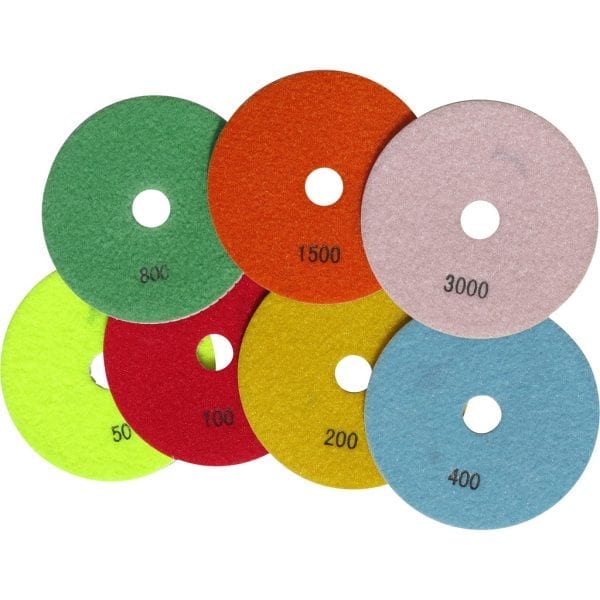
A very coarse metal bond cup wheel removes a great deal of material very fast. That’s its job. But it leaves an uneven, gouged surface suitable only for sidewalks. Most often a coarse resin bond disc (often 50 grit) is used to flatten the surface and remove the gouges from the cup wheel. Next a 100 grit disc further refines the surface, removing the visible scratches left from the 50 grit. And finally the 200 grit does the same thing. In fact each finer grit simply refines the surface and removes the scratches left by the previous, next-coarser disc. This is true of the 100 grit, and it’s true of the 3000 grit disc.

But the 200 grit disc is special because it represents a point in the production stage in a concrete countertop where many things can happen. Grouting is performed after the surface is honed to a 200 grit finish. Chemical densifiers are applied to a 200 grit finish (if polishing is going to occur), and most importantly, nearly all coatings are applied to a 200 grit finish.

Grouting occurs at the 200 grit stage for a practical reason. Most 100 grit pads leave small tool marks (multiple crescent-shaped scratches) that are hard to see when the concrete is unfinished, but when filled with grout they often show up after sealing. This is not acceptable to clients. On the other hand, good quality 200 grit pads do leave minor swirl marks, but these are not deep enough to be filled with grout, so therefore don’t show after sealing. In addition, hardened grout is removed with a 200 grit pad. If grout was removed with a 100 grit pad, not only would the surface have 100 grit scratches in it, the coarser pad is too aggressive and will cut deeper into the concrete and expose more pinholes, requiring further grouting. A 400 grit pad may not be aggressive enough to efficiently remove the hardened grout in a reasonable amount of time, and the smoother finish may prevent a coating-type sealer from sticking (more on that later).

A concrete surface honed to a 200 grit finish is satin-smooth to the touch but looks nearly dead-flat in sheen. If the concrete is to be polished, densifiers are applied at the 200 grit stage (after grouting) so that the cement paste can be hardened and polished along with the sand and aggregate. Chemical densifiers (especially the popular lithium based ones) leave a micro-thin, hard, transparent deposit that helps to fill in the micro-texture left by the 200 grit pad. Generally polishing begins at the 400 grit stage, when very little material is removed. Having the surface already densified before polishing begins makes the process more efficient and results in a better looking surface.

Because a 200 grit surface has a very slight micro-profile, it’s perfect for applying coatings. Most coatings rely on a mechanical bond to adhere to the concrete. Very smooth surfaces don’t allow a good bond, so coatings are at risk of peeling. And nearly all coatings leave a thin film of material that completely obscures the smooth profile of a polished surface. Even if the coating would form a reliable bond it’s a complete waste of time to polish at all. You simply cannot tell the difference between concrete honed to 200 grit and concrete polished to 3000 grit after they have been sealed with a coating.

So remember, if you’re using a coating sealer, stop polishing at 200 grit. Going any further is a waste of time and could compromise the sealer’s adhesion.

Buffing roller marks in a topical concrete countertop sealer

One further question about the article “Deciding on a concrete countertop sealer in Grand Cayman” was:

“What did you do to buff the roller marks away?”

Ideally, here is how you prevent roller marks:

  • Put the finish down fast
  • Roll everything to the same film thickness (quickly)
  • Minimize the amount of overrolling and backrolling
  • Keep all areas rolled the same amount

In practice, you are almost always going to end up with a few marks.

There weren’t really any major physical roller marks, rather most of the roller “marks” were sheen variations. The sheen variations occurred because of areas that had been rolled more than others. Backrolling, drips, roller holidays and simply working around the columns necessitated going over areas more than once. Usually with matte finishes the sealer loses sheen more in areas that are over-rolled and that have a thinner film thickness.

For the few areas that had small bumps or minor roller texture, I first sanded with 400 grit sandpaper on a random orbit sander. To even the sheen a bit more I used a common green 3M scrubbing pad on the random orbit sander. This made the duller areas shinier and the shinier areas duller, evening out the sheen and obscuring the roller marks.

Another great question, Paul. Keep them coming!

Color enhancement in concrete countertop sealers

I recently got a question regarding my article “Deciding on an outdoor concrete countertop sealer in Grand Cayman“:

“You never mentioned if the ‘pop’ in color is the same as a dry vs. wet look. I’ve applied sealers and although they looked matte, they still made the concrete look darker than before sealer is applied. Will this method [Stonelok 2K] change color?”

When a sealer “pops” the color of the concrete, it’s making the color seem richer, darker and more vivid. This is similar to what water does when it wets out the surface of concrete. A dry piece of concrete often looks very light, dull and lifeless. But when you wet it with water or seal it with certain sealers, the concrete comes to life, the color is truer and more vivid. This is all because of the way the sealer (or water) helps visible light reflect off the concrete.

Dry concrete scatters a lot of white light, so most of the light shining on it is scattered. The result: the concrete looks pale and lifeless.

light reflection rough

Wet concrete, polished concrete and concrete sealed with certain sealers reflects more of the light as colored light (the color of the concrete) and has less white light scattering. That’s why the concrete looks richer and more colorful.

light reflection wet surface

“Wet-look” sealers are sealers that make the concrete look like it’s wet with water. They pop the color and are typically very glossy. Not all finishes that pop the color make the concrete glossy. But high gloss finishes give the “wettest” look because of the combination of gloss and low white light scatter.

All sealers will affect the depth of color somewhat, although some waterbased acrylic sealers do very little to deepen the color. In effect they are the opposite of wet look sealers. Though the surface might be shiny from the acrylic, the color of the concrete still looks pale as if it were dry and unsealed. Every sealer is different, so you have to test the sealer to see whether its effect on the concrete’s color depth is what you want.

Stonelok E3 is a water-based epoxy that is used as a primer under Stonelok 2K (a waterbased urethane). E3 pops the color and is glossy. It’s not used as a sealer because it scratches too easily. Its job is to pop the color and to enhance the bond between the concrete and 2K. Stonelok 2K (the extra low gloss version I used) still pops the color a little bit, but not nearly as much as E3 does. The small amount of pop was acceptable to me and my client. I did test the E3 on a sample and didn’t like how it looked. That’s why I didn’t use it.

Thanks for the question Paul, and I hope that helps.

(I also covered this topic in a recent article for Concrete Decor Magazine.)

Deciding on an outdoor concrete countertop sealer in Grand Cayman

The outdoor gazebo I’m working on in Grand Cayman will be used to serve coffee in the morning and drinks in the afternoon. So we’ve got an outdoor concrete countertop that will be used much like a bar. The owners wanted:

  • Very natural look
  • Resistant to coffee and wine
  • Stays looking nice long term

I debated between using a densifier/repellant conbination or a high-performance coating. Densifier/repellant would provide a very natural look, but they would not provide great stain resistance and therefore not stay looking nice long term.

Some coatings provide excellent stain resistance. But, coatings can scratch, and that would not satisfy the long term look criterion. And, some coatings are glossy or plasticky. Fortunately, the two coatings I recommend (StoneLok E3/2K and RapidShield UV) are very scratch resistant and look very natural.

Overall, I chose StoneLok because:

  • UV-cured sealers cannot be applied outdoors, so RapidShield was automatically out
  • It has a long track record of success, both indoors and outdoors
  • I have a lot of experience with it
  • I’ve tested it
  • I have it on-island already
  • StoneLok has some of the best scratch resistance performance for a coating
  • StoneLok looks very natural and is available in extra-low gloss

Now I just had to decide how to apply StoneLok. Spraying would be a challenge outdoors, where it is always breezy. Rolling could leave roller marks, but those can be buffed out, so I decided to roll.

If I used StoneLok E3, it would pop the color. This did not look as natural as the clients wanted. Without E3, just 2K provides a little less stain resistance, but tests show that the resistance is still very good. So, I chose to use just 2K.

So there you have it. StoneLok 2K Extra-Low Gloss it is! Sealing day went great, and I came back the next day to buff out the roller marks with a green Scotch Brite pad. Now I will just have to have a few glasses of wine at the bar once it opens, and see how beautiful it looks!

roller marksRoller marks in the sealer

even sheen

Even sheen after buffing

My concrete countertop sealer epiphany

Recently I had an epiphany that I would like to share with the world. It isn’t earth-shattering, it isn’t revolutionary and it’s not even that radical. However I believe that it is important, so I’m taking the time to write this.

For many, many years I have used coatings to protect my concrete countertops. I am a strong and vocal advocate for using a high performance coating to protect concrete from stains and acid, and I’ve invested an extraordinary amount of time and resources testing and reporting the stain performance of a wide variety of sealers. My recent epiphany isn’t really about sealers directly, and it doesn’t contradict my position on them. What it does do is paint a broader and more coherent picture of their place and how we all can be successful with our concrete.

We, the concrete countertop industry, are in a strange and precarious position. Other countertop materials have well-defined and widely accepted identities. Everyone who looks at, buys, wants, uses and works with those materials has an idea of what those materials are, and everyone’s pretty comfortable with the way they are. Those countertop materials are accepted, even coveted some may say, at face value. Concrete isn’t given that freedom of acceptance; it’s not given the same benefit of the doubt. So we, purveyors and crafters of concrete have to dig into our bag of tricks and make compromises in an attempt at satisfying challenging, difficult and sometimes impossible demands.

I’m not going to start a dialog on the virtues of such-and-such sealer, or what fantastic new technology is going to solve all our problems. We all are wise enough to know that right now there’s nothing that satisfies everyone; someday perhaps, but not right now. What I am going to say has to do with responsibility. When I’m done, perhaps it will become the map that helps you find the path you’ve been looking for.

When a client chooses Carrara marble, she does so deliberately. Carrara marble has a very rich heritage that is at the source of its wide appeal. It was prized by the Greeks and Romans and widely used as a sculpting material during the Renaissance; Michelangelo carved the statue of David from a block of Carrara marble. The historic and contemporary value of Carrara marble is unquestionably high. Its luminous beauty and refined texture elevate it to super-premium status where it exemplifies high design and expensive taste.

Carrara marble countertop

Although it is highly valued for its rich heritage and aesthetic qualities, Carrara marble is actually a relatively poor material to make a kitchen countertop out of, in a practical sense. Marble is a soft and porous stone, and Carrara’s light color makes almost any stain stand out. Marble is vulnerable to common acids like vinegar and lemon juice.

Despite those limitations, Carrara marble is still viewed as a desirable and valued material. The natural stone industry and consumers are aware of and accept Carrara marble’s physical limitations, yet little is done to improve or protect the material. It is unheard of to apply a coating to Carrara marble. At best a penetrating repellant or a coat of wax is all that is tolerated.

At the opposite end of the spectrum from Carrara marble is a relatively new and popular countertop material. Engineered quartz is a synthetic composite of quartz aggregate in a durable resin binder. This combination yields an extremely durable countertop surface that often carries 10 to 15 year warranties, and its physical properties convey a nearly stain- and acid-proof surface. Its manufacture provides all the protection, so no sealing and no maintenance are required. These factors, along with the broad range of aesthetic choices offered by the engineered quartz manufacturers make it a popular choice and a strong competitor to granite.

engineered quartz countertop

Not to be outcompeted by a synthetic material, most granite on the market today is resin impregnated. This makes the granite nonporous and greatly increases its stain resistance.

Both of these materials, engineered quartz and resinated granite, provide very durable, virtually maintenance free surfaces that can stand up to most anything a homeowner can spill on it.

So where does concrete fit in? From a custom, high-end material standpoint it’s in league with Carrara marble. No other material can look and do and be what concrete can.

Unfortunately, most of the clients concrete is presented to think it’s just another countertop material, and that almost all home-center grade countertop materials perform similarly, providing nearly maintenance-free stain-proof performance. It’s not surprising that most clients ask for, or even demand that kind of performance.

And that leads me back to where I started. You can, and have always been able to, provide your clients with a surface that will stand up to heat, mustard, vinegar and oil (amongst many other sauces and lotions and liquids). Not only do they want “stain-proof”, they want absolutely zero maintenance. No waxing, no resealing, nothing, because even if they had to do it they wouldn’t. After all, if they can’t even keep the countertops clean, do you think they’d apply a sealer every so often, or even once? Not likely. Such performance is possible, but it comes with a price, and that price is that you must use a coating.

These homeowners want to be absolved of any responsibility for keeping the countertops looking like new. In their mind, that’s what the sealer is for. They want to be slobs and not have to worry. And they can, but to get close to what most clients want requires a very high performance coating. A coating that stands up to everything a homeowner can spill on it, and one that does so every time it’s used and on any kind of concrete it’s used on. This places all of the responsibility on you, the concrete countertop manufacturer.

You bear the burden of choosing a finish that stands up to everything you anticipate the client will do. Choose poorly, and you’ll pay the price with callbacks, lost revenue and even lost business. Choose correctly and you can sleep well, knowing your concrete will look like new for a long time.

So where am I going with all of this? I’m not driving you towards one end solution. What I want you to do is think about your concrete and your clients and your message. Are you selling Carrara marble or are you selling engineered quartz? Neither is wrong, but both require an explicit and very clear understanding of responsibility.

If you choose to sell concrete like Carrara marble, tell your clients that 100% of the responsibility for upkeep and maintenance is on them. If you choose to sell concrete like engineered quartz, then take 100% of the responsibility for engineering its performance so that no care and maintenance are required of the client.

Think about this: Whom do you want to bear the responsibility for keeping your concrete looking like new? You or your client? 

While either choice is acceptable, the end product, the concrete, looks, feels and performs differently. You’re not making the same “stuff” and packaging it two different ways. They are different animals, and are looked at and valued in fundamentally different ways. Both are high value. Both are correct, but both must be matched to the right client. If not, then no one will be happy.

Lastly, a word of caution. I believe most of the headaches, callbacks and problems people have had stem from the fact that the finishes conflicted with the defined roles of responsibility.

If I use a finish that provides a good deal of protection, but it gradually wears off, then that finish requires periodic reapplication. If I select a finish that stands up to some common staining agents but not others, then that finish doesn’t provide the kind of protection the client wants. The line of responsibility is vague and shifts. Using some kind of finish that offers limited protection is worse than using none at all because at some level the client knows I’ve sealed the concrete, so the expectation is that staining won’t happen, or it won’t happen so badly, or that it shouldn’t happen. But it will, so in their mind I’ve let them down, even though I set their expectations up front.

This scenario has played out for many concrete countertop makers over the years.

If I simply wax bare concrete, then the client knows, up front, that just about anything will stain the concrete and that they had better take great care and clean up any spills. If they do that then “bad things” won’t happen. And if they do, it’s obvious where the fault lies.

On the other hand, if I coat the concrete with a high performance, reliable coating, then nothing short of gouging the concrete will damage the finish. The homeowners don’t need to do anything. In fact they don’t even need to keep the countertop clean. All the responsibility is on me.

It’s that gray area in between, with finishes/treatments/coatings/whatever that provide limited protection, or only work some of the time for some of the people, or are too difficult to get to work, or simply don’t work when tested despite what’s written on the bottle or posted on a forum. With these types of finishes the line of responsibility is vague. It shifts. It’s movable, and you can be sure that when bad things happen the client will push the line in the direction most favorable to them. And that means you pay the price.

So, are you selling Carrara marble, engineered quartz, or are you caught in between, in the gray area of frustration, callbacks and lost profits? It’s up to you. Just be clear about where you stand.

New kits of recommended concrete countertop sealer Stonelok E3/2K

One of the recommended concrete countertop sealers, Stonelok E3/2K, now has kits available.

Kits are available in gloss, low gloss and extra-low gloss (satin).  All kits are pre-measured and include all components including the OS-W substrate conditioner, E3 epoxy primer and 2K urethane topcoat.

40 square feet (1 choice of sheen) – $149.95 (CCI members $139.95)
80 square feet (2 choices of sheen) – $209.95 (CCI members $199.95)
120 square feet (3 choices of sheen) – $309.95 (CCI members $259.95)
400 square feet (3 choices of sheen) – $659.95 (CCI members $599.95)

Click here for information about CCI membership.

Kits contain detailed instructions and:

Kit Size OSW E3 2K
40 sq ft 30 ml 24 oz 12 oz
80 sq ft 60 ml 48 oz 24 oz
120 sq ft 112 ml 64 oz 36 oz
400 sq ft 234 ml 1.5 gal 1 gal

For more information on the CCI-recommended sealers, click here.