The oft-neglected step between templating and forming a concrete countertop

You know that templating and then forming are basic steps in concrete countertop making. But have you thought about the very important, but often neglected, step of slab layout? Slab layout should be carefully considered, first on a practical level and then on an aesthetic level.

The first step in slab layout is to determine the maximum length of slab that you can get into the house or space. Note during templating whether there is a tight corner you’ll have to carry the slabs around, or a narrow staircase you’ll need to climb. Although you may have the technical ability to make 20-foot long slabs (at least from GFRC), if you can’t physically get the slabs into the house, it doesn’t do you any good. (We’re talking precast here, of course. You could go the cast in place route depending on the look desired and the site conditions.)

Let’s say you’ve determined that the maximum length of slab for a kitchen countertop you’ve templated is 8 feet. At your shop, lay out all the templates on casting tables, right side up, as close as possible to the actual layout of the kitchen.

You will usually need a seam at the kitchen sink. Kitchen sinks tend to be placed in long, straight runs of countertops, which may exceed your maximum slab length. Usually the easiest way to seam a kitchen sink is to make one short seam in the center of the sink, lined up with the cabinet seam.

Sink with seam in center, front and back

Try to keep adjacent slab sections similar in size, rather than having one long piece abutting a very short piece. This looks odd and unbalanced.

If a slab must be “L” shaped in order to turn a corner without excess seams, the longest practical length for the shorter leg of the “L” is usually about 5 feet (measured on the outside of the L).

Other than these general rules of thumb, most of slab layout is aesthetics. Pay careful attention to the cabinet seams (defined by the center of cabinet doors, or the line between two cabinets). Nothing looks worse than a countertop seam 1″ off from a cabinet seam, or worse, a few millimeters.

Poorly placed seam - a few millimeters too far to the right

Also think about how the client will view the countertops in the room. Is one section visible from the main door into the kitchen, and usually spotlighted in a ray of sun? Then maybe it’s worth a little extra effort to avoid a seam right in the middle of that section, since the client will see it every time she walks into the room.

Once you’ve determined where you think the seams should go, draw the seams on a kitchen plan and have the client sign her consent. That way there will be no misunderstandings or disappointments later. Many clients get extremely emotional about every little detail of their kitchens. A decision that seemed like no big deal to you can seem like the end of the world (and the end of your profits) to a client.

Once the seam layout is finalized, draw the seams on the templates and cut them with kerfless shears. These cut templates will be what you form around. And since you’ve taken the time to create a carefully considered seam layout, you know your forms will create the perfectly sized and fitted countertops for your client. And a perfect product means a happy client!

An easy way to create eased edges on a concrete countertop

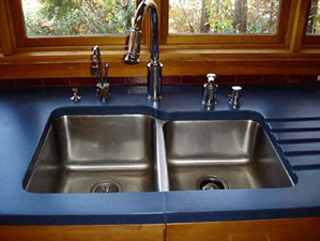
Easing the edges around sink openings in concrete countertops is important to prevent chipping and to provide clients with a smooth, comfortably rounded edge. There are a couple of ways to do this: shape the edge by hand after casting, or form the roundover before casting.

While shaping the cast concrete is practical for straight edges or outside curves, it’s often difficult to do on tight, inside curves like those found in an undermount sink opening. And getting a smooth, even curve does take some practice, even with a special grinder and roundover bit.

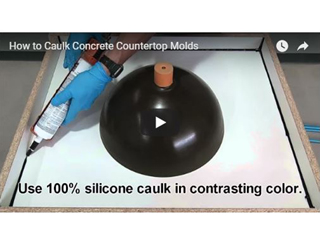
One way to form a roundover before casting is to run a bead of caulk and carefully smooth it to the right radius, and then let the caulk cure, usually overnight. While this works, it’s time consuming, messy, and getting it right takes practice.

Try this instead: Get some non-hardening plastic modeling clay from the craft store. Any color will do! Roll out a rope of clay about 1/4″ diameter (or more for bigger roundovers) and pack it into the corner or edge to be rounded over.

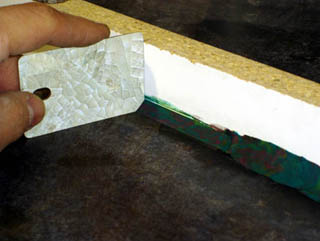
Next, make a shaped scraper. A piece of thin wood template stock works, but an even better (and free) scraper is made from a laminate sample chip. Sand or file a different radius onto each of the 4 corners: 1/8″, 3/16″, 1/4″, 3/8″, or whatever you want. You can even do bevels or other shapes too.

Once the clay is packed in the corner between the form side and the casting table, scrape the excess clay away using the scraper. The radiussed corner will cut and scrape a smooth, even shape into the clay. The form is then immediately ready for oiling and casting.

Once stripped, the clay can be pulled from the concrete and reused. A degreaser like Greased Lightning makes short work of any clay residue, and a power washer gets out any clay that becomes smeared into the voids.

Modeling clay for edging

Making a GFRC concrete monolith

When you use GFRC to create concrete elements, making intricate designs is easy, but there are a few tricks to keep in mind, and it does require meticulous attention to detail.

I made what I call “the monolith” for our trade show booth. It’s really a self-standing concrete sign. This is a great product for businesses – you can offer a vertical, 3-dimensional concrete element that is also extremely functional.

The photo series below shows the basic steps in creating the monolith using GFRC. This monolith could have been created using wet cast techniques, but I would have needed a two-sided mold, and vibration could have moved the knockouts inside the mold.

I printed out letters on paper, glued the paper to insulation foam of the desired thickness, then cut out the letters with a scroll saw. I did the same with my logo. This took a lot of time. Alternatively, you could have a sign company create plastic letters and logo based on an electronic file you send them.

Cutting foam letters

I built the mold from melamine and glued in the foam letters. To create a recess, I used a strip of plastic with orange vinyl tape wrapped around it to create a smooth surface. I also used pieces of plate glass. In the photo below, Brad and I are pulling away the excess silicone caulk.

Pulling silicone

After spraying the mist coat, I had to use a brush to get into every tiny nook and cranny. This was very important to ensure a clean, crisp shape that picked up all the details of the lettering.

Packing mist coat

Picking out the foam from the finished piece was very tedious!

Removing foam

I added LED strips to the back of the plate glass pieces. Note also the four buttresses to create strength, like an airplane wing. The buttresses are foam wedges covered with backer coat.

Adding wiring

The finished monolith/sign. (There is also a river of glass in the base. How to create that is another topic.)

Finished monolith

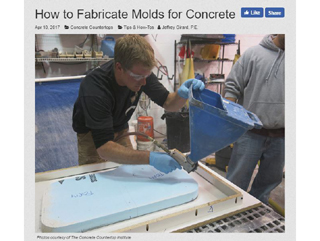
The right way to build forms for concrete countertops

There is no one right way! The only requirements for concrete countertop forms are that they be dimensionally correct and made out of materials that will not warp (unless you are using dynamic fabric forming, but that’s another topic).

That said, there are two basic methods to forming, depending on whether you want an as-cast finish (“pop a perfect slab”) or you plan to grind to expose aggregate or create a polished finish (“grind and grout”).

If you want to pop a perfect slab, the casting surface must be absolutely perfect, because every little bump, scratch or spot will show up in the cast concrete. Very fluid mixes that can be vibrated to reduce surface pinholes need to be used with this method. These mixes are highly liquid and require watertight forms. You cannot use form release agents in your forms.

I long ago gave up on the pop a perfect slab method. It is simply too difficult to get a perfect, blemish-free, pinhole-free surface on a consistent basis. And, creating perfect, watertight forms is a lot of work. You end up forming and casting multiple times trying to get a perfect finish. I would rather spend time at the end grinding and grouting. I also feel that this is a more true to concrete look. Why hide the sand grains? Plus, the fine cement skin left on in the pop a perfect slab method is extremely fragile and hides tiny pinholes just below the surface. If that skin is damaged, it is impossible to repair.

For the grind and grout method that I prefer, the forms still need to be dimensionally perfect and smooth. But, there is a much wider variety of forming materials you can use and a wider variety of looks you can create.

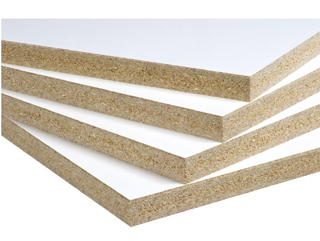
For flat countertop slabs, I use strips of melamine and steel angle iron on a steel-topped casting table. The melamine is glued down with Power Grab, and the angle iron is clamped onto the edge of the table. Cresset’s Crete-Lease 880 VOC is the form release agent.
Forming with steel

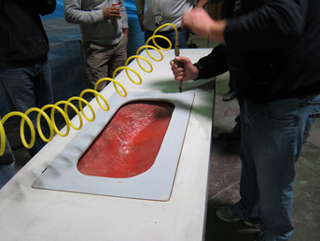
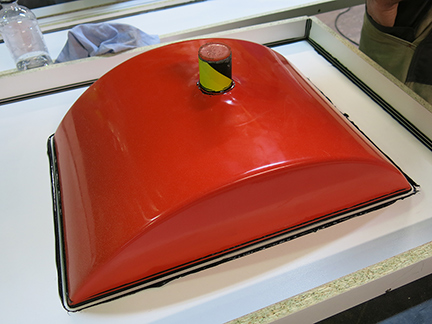
For sink and faucet knockouts, I use blue insulation foam cut with a jigsaw or router and smoothed with a disk sander. There is no need to tape the edges of this foam.
Smoothing foam

I also use a router to cut the foam using a Masonite template as a guide.

With these simple to assemble materials, creating an accurate, stable form is quick and easy.

Concrete Countertop Mixes: Stiff versus Fluid, part 2 of 2

This article concludes the discussion of stiff versus fluid concrete countertop mixes, with the final three differences.

Difference #3: Mix Design

Stiff Mixes

Stiff concrete mixes can be either all-sand mixes (no coarse aggregate) or coarse-aggregate based mixes. Generally they are all-sand mixes due to the ease of spreading and packing a fine-grained clay-like concrete. Coarse aggregate makes the mix “chunky”, often making hand-packing difficult or uncomfortable.

All-sand mixes have far more surface area, so require more cement paste. But the fine grained nature of sand inhibits movement due to the increased particle friction generated from many times more contact points. All-sand mixes are typically stiff, zero slump. It is possible to make anall-sand mix fluid with a combination of a powerful superplasticizer and strong vibration, but this is rarely done.

Fluid Mixes

Fluid concrete mixes are generally based on coarse aggregate.  Aggregate based mixes are more easily made fluid because of the large amount of coarse aggregate in the mix. Pound for pound, coarser aggregate has less surface area than fine sand. A mix that has less surface area requires less cement paste to coat the particles, and any excess paste in the mix acts as lubricant, allowing the particles to move past each other more easily.

Difference #4: Forming Techniques

Stiff Mixes

Because of the nature of stiff mixes, watertight forms are not necessary. As such, careful caulking of the seams isn’t required. If the form edges are caulked, it is because a cast rounded edge is desired instead of grinding a rounded edge. Forms should be tight, but the added step of caulking is not necessary.

Fluid Mixes

It’s a different story with fluid concrete. The forms must be watertight with fluid concrete because any leakage will result in discoloration of the concrete and loss of material.

Fluid concrete also requires that reinforcing steel be tied to the sides of the forms, since the steel will sink if simply placed in the form. However, it is very important not to pour the concrete over the steel. Doing so will result in ghosting. To prevent ghosting, either tie the steel after the forms are mostly filled with concrete, or very carefully pour the concrete through the holes between the steel, taking care not to pour onto the steel. Also, if the concrete is to be vibrated, the steel must be tied in place so that it does not move.

Comparison of Forms

Stiff mixes require less form work than fluid mixes when complex or 3 dimensional pieces are being cast. This is especially true for integral sinks cast into countertops. On the other hand ordinary flat countertop slabs use essentially the same forms for both stiff and fluid mixes.

form for fluid concrete countertop mix

Fluid concrete mixes need more complex forming for an integral sink.

form for stiff concrete countertop mix

Stiff mixes require less forming because the concrete is self supporting.

Difference #5: Casting Effort

Stiff Mixes

Stiff mixes take more effort to cast, and if care is not exercised in placement, air will get trapped between the concrete and the form. This results in large, shallow “craters” that often are on the order of 1/16”deep. The resulting surface is ugly and inconsistent in appearance, and it is difficult to repair by grouting.

craters in stiff cast concrete

Fluid Mixes

Fluid mixes are quick and easy to cast, as long as you take care with the reinforcing steel as noted in Difference #4: Forming Techniques.

Conclusion

As you can see, the choice of a stiff mix versus a fluid mix has many implications for all steps of the concrete countertop production process. Understanding the interplay of these implications is important for producing a high-quality concrete countertop.

Concrete Countertop Mixes: Stiff versus Fluid, part 1 of 2

There are several considerations to make when choosing a concrete countertop mix consistency. Some factors include the appearance of the finished piece, the forming and casting methods, and the complexity of the mold geometry.

Other factors that are not so obvious also drive the selection process. These can include the type of mixer that will be used, how the forms are assembled, the shrinkage tendency of the concrete and subsequent vulnerability or resistance to curling and hairline shrinkage cracks.

This article outlines the basic differences between two mix styles, stiff and fluid, in design, look and technique.

There are two basic types of mix consistencies: stiff and fluid.

A stiff mix is a versatile, all-purpose mix that can beadapted to a wide variety of looks, from a “solid” appearance, to a variegated/veined, or a terrazzo look. A stiff mix is typically made using only sand as an aggregate, and it has zero slump.

zero slump concrete countertop mix

A fluid mix is a high slump mix that is more conventional in its ingredients, since it uses both fine and coarse aggregates. While coarse-aggregate based mixes are easy to make fluid, it’s vital that the fluidity is achieved by using superplasticizers and not by adding water. Concrete countertops require high quality concrete for aesthetic and long term performance, and using water to enhance workability instead of superplasticizers results in weak concrete that is prone to shrinkage, curling and cracking. Of course being disciplined with mix water applies to all types of concrete, but fluid concrete is more susceptible to water abuse.

flowable concrete countertop mix


Difference #1: The Look

Stiff Mixes

Stiff concrete mixes will always have voids in the cast surface. This is because the cement paste (and the mix as a whole) is so stiff that the entrapped air bubbles cannot escape. Often larger voids are irregularly shaped, and this tends to lend a more organic, stone-like look to the concrete.

pressed concrete stool

small round sink in concrete countertop

copper embedded in concrete countertop

variegated integral sink concrete countertop

The fact that the concrete is stiff and will always have air pockets can be exploited by purposefully introducing voids and patterned fissures. The resulting look resembles the veins in natural stone. Sometimes the voids are left open, but more often they are filled with contrasting cement grout. This highlights the voids and reinforces the resemblance to natural stone.

Fluid Mixes

Fluid concrete creates castings with very high surface quality. Edges are crisp and precise. Surface color and visual texture is smooth and even.

fluid mix pinholes

ramp sink in concrete countertop

Fluid concrete mixes can sometimes have a few small pinholes, or if the casting is done carefully, no pinholes at all. Concrete can be made fluid by using an appropriate mix design and superplasticizer, or astiff mix can be made fluid by vibration. Either way the cast surface will very closely reflect the surface characteristics of the mold. If the concrete was cast against smooth, glossy plastic then the virgin cast surface will be shiny and almost glass-smooth.

Difference #2: Casting Techniques

Stiff Mixes

Stiff concrete is placed by hand, often in small handfuls.The stiff nature of the mix allows the concrete to be packed onto vertical forms and place in thin layers.

hand packing sink form

hand packing in form

Fissured concrete, sometimes called variegated or hand-pressed concrete, is placed so that air gaps between areas of concrete result in fissures once the concrete is demolded.

variegated round table

Fluid Mixes

Fluid concrete is often poured into forms, but it can also be placed by hand.

describe the image

casting fluid concrete countertop mix


The next article will explore three more differences between stiff and fluid concrete countertop mixes.