How to choose the best diamond pad for concrete countertops

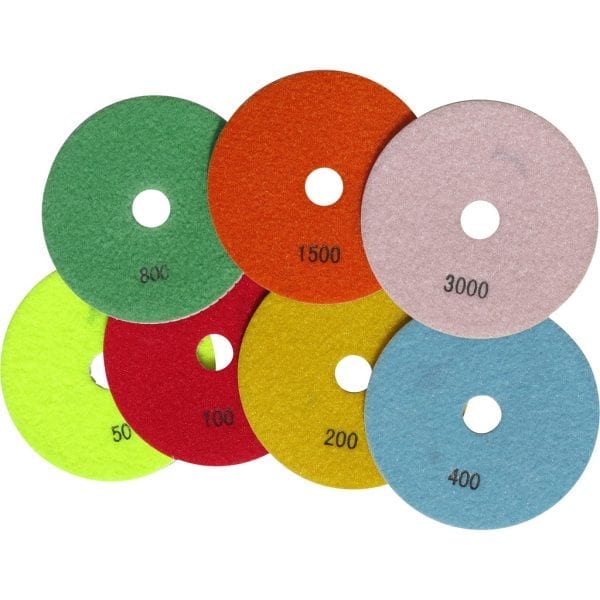
Selecting the right diamond polishing pad (or disc) is the key to getting a good finish for your concrete and getting the most bang for your buck.

There are many different sources, names, styles and prices for diamond pads on the market. This can be very confusing, and what often happens is selection comes down to price. This is unfortunate, because in many cases a cheap pad will cost you more in the long run. However, I’m not suggesting we all go out and spend $100 per pad either. There’s a place for those, and we don’t need to go there (granite folks might though).

Choosing the right pad starts with assessing what you plan on doing with it.

  • Are you using it for heavy stock removal?
  • Is it for general honing?
  • Are you polishing the concrete to a high gloss?

Each of these tasks will influence the choice in pad. I’ll outline some of the variables to consider and then create a general template for selecting the right pad for the right task.

Size

Larger diameter pads (e.g. 7″) are much more stable on large, flat areas than smaller diameter pads (3″ and 4″). However, larger pads become unstable on narrow sections of concrete. A 7″ diameter pad won’t stay flat or cut evenly on a 3″ wide strip of concrete. They are also difficult to use on the vertical edges of countertops.

Small diameter pads are less stable and more likely to gouge when processing large areas on a big polisher, but with a smaller polisher (espcially a pneumatic polisher) they work very well for processing edges and narrow sections.

A good all-around size is a 5″ diameter pad. Many low-cost polisher package deals come with 4″ pads. These can be difficult to control with hand held polishers on concrete. Smaller 4″ pads are really meant for use on hard stone, which is much less prone to gouging than concrete.

Thickness

Diamond pads come in a variety of thicknesses, from around 2mm thin to 8mm thick.

Thicker pads will last longer, but thicker pads are stiffer, and sometimes are prone to cupping when they dry.

Thin pads don’t last as long (especially when aggressively cutting), but they are more flexible. This is a big advantage when honing or polishing inside curved integral sinks.

Pattern

The pattern molded into the cutting surface plays a significant role in the lifespan and the cutting quality.

Often pads used for coarse honing (30 and 50 grit) have an aggressive, open pattern with wide and deep channels. Pads with large, open channels allow the abrasive cutting residue to be ejected quickly and effectively. This increases the lifespan of the pad when aggressive stock removal is performed. 

Pads that have many narrower channels are best only for polishing (400 to 3000 grit), where almost no stock is removed. Narrow channels clog more readily when aggressive cutting is performed and when insufficient water flows out from under the disc. 

A good balance of these factors is lots of channels that are large in proportion to the diamond-covered surface. This provides flexibility to the pad while still allowing for effective ejection of cuttings and a large proportion of diamond area. In contrast, pads with very large channels and very large “islands” of diamonds tend to be inflexible.

Diamond Quality

While it’s very easy to see the thickness and channel pattern in a diamond pad, it’s nearly impossible to assess the quality of the diamonds used in the pad, or for that matter, the grading and quantity of diamonds. Ultimately it’s the diamonds that do the cutting, and they are what makes a pad expensive. The better the quality of diamond, the better the grading and the more diamonds in the pad, the more expensive the pad will be.

It’s possible to find $1 pads and $100 pads that look almost identical. What’s not visible are the diamonds, and that’s where you need to trust your supplier to inform you of what you’re getting.

The most expensive pads use the best industrial diamonds. The diamond concentration is high (each manufacturer optimizes the quality and quantity of diamond in their pads), and the gradation is narrow. Like sand and gravel, diamonds come in a variety of sizes. A narrow gradation means almost all of the diamonds are about the same size, so the grit number of the disc is a more precise description of the diamond size gradation. Any variation tends toward smaller diamonds, which don’t affect the quality of the concrete surface.

Cheap pads use low grade diamonds. These tend to have more flaws and much poorer gradation. In addition, fewer diamonds may be used in the pad. Often the gradation is broader, so a 100 grit pad may actually have significant amounts of smaller diamonds and some coarser diamonds (like 70 grit). This results in a lower surface quality (more scratches) and slower cutting (because there are more smaller diamonds in the pad).

Binder

The binder that encapsulates the diamonds is just as important as the diamonds, and it has a profound effect on the performance and longevity of the pad. Binder materials range from ceramic to resin, and different materials are used for specific applications. Binder hardness is important. A binder that’s too soft will wear away quickly when processing an abrasive material like concrete.  

Nearly all wet polishing pads use a resin binder, and resins vary. It’s very rare that a pad distributor will describe the binder with any meaningful detail, so here personal observations and reliance on trusted recommendations are necessary to make a good choice. Too often the least expensive pads use soft resin binders that wear away quickly. If you end up using three times as many pads as you would with a pad that costs twice as much, you are not saving money in the end.

Ceramic binders tend to wear better and stand up to higher temperatures than resin pads. Many dry pads use a ceramic binder, which helps to prevent the smearing and glazing that can occur when a resin based dry pad is run at a speed that’s too high.

Recommended Diamond Pads for Concrete Countertops

The Concrete Countertop Institute has developed diamond pads specifically designed for concrete countertops, not granite and not concrete floors.

These pads have all the features you want in a diamond pad for concrete countertops:
- High concentration of diamonds for faster cutting
- Narrow gradation of diamonds for a swirl-free surface
- Thick enough for long life
- Thin enough to be flexible
- Ideal channel design to eject slurry and prevent clogging
- Ideal resin binder for long life without glazing

Click here for pricing.

diamond pads

Diamond Pads

Why is the 200 grit disc special for concrete countertops?

Most concrete countertops are processed using diamond discs. Two common looks are exposed aggregate and a “salt-and-pepper” look. Exposing aggregates requires very coarse discs, often metal bond cup wheels, while a salt-and-pepper look has just the sand particles exposed.

Regardless of the first grit that was used, processing always follows a progression of finer and finer grits. At some point the 200 grit is reached. With some instances this could be the very first grit used on the concrete (when only a very light honing is required).

The 200 grit disc is a special grit and represents an important point in the processing stage of a concrete countertop.

A very coarse metal bond cup wheel removes a great deal of material very fast. That’s its job. But it leaves an uneven, gouged surface suitable only for sidewalks. Most often a coarse resin bond disc (often 50 grit) is used to flatten the surface and remove the gouges from the cup wheel. Next a 100 grit disc further refines the surface, removing the visible scratches left from the 50 grit. And finally the 200 grit does the same thing. In fact each finer grit simply refines the surface and removes the scratches left by the previous, next-coarser disc. This is true of the 100 grit, and it’s true of the 3000 grit disc.

But the 200 grit disc is special because it represents a point in the production stage in a concrete countertop where many things can happen. Grouting is performed after the surface is honed to a 200 grit finish. Chemical densifiers are applied to a 200 grit finish (if polishing is going to occur), and most importantly, nearly all coatings are applied to a 200 grit finish.

Grouting occurs at the 200 grit stage for a practical reason. Most 100 grit pads leave small tool marks (multiple crescent-shaped scratches) that are hard to see when the concrete is unfinished, but when filled with grout they often show up after sealing. This is not acceptable to clients. On the other hand, good quality 200 grit pads do leave minor swirl marks, but these are not deep enough to be filled with grout, so therefore don’t show after sealing. In addition, hardened grout is removed with a 200 grit pad. If grout was removed with a 100 grit pad, not only would the surface have 100 grit scratches in it, the coarser pad is too aggressive and will cut deeper into the concrete and expose more pinholes, requiring further grouting. A 400 grit pad may not be aggressive enough to efficiently remove the hardened grout in a reasonable amount of time, and the smoother finish may prevent a coating-type sealer from sticking (more on that later).

A concrete surface honed to a 200 grit finish is satin-smooth to the touch but looks nearly dead-flat in sheen. If the concrete is to be polished, densifiers are applied at the 200 grit stage (after grouting) so that the cement paste can be hardened and polished along with the sand and aggregate. Chemical densifiers (especially the popular lithium based ones) leave a micro-thin, hard, transparent deposit that helps to fill in the micro-texture left by the 200 grit pad. Generally polishing begins at the 400 grit stage, when very little material is removed. Having the surface already densified before polishing begins makes the process more efficient and results in a better looking surface.

Because a 200 grit surface has a very slight micro-profile, it’s perfect for applying coatings. Most coatings rely on a mechanical bond to adhere to the concrete. Very smooth surfaces don’t allow a good bond, so coatings are at risk of peeling. And nearly all coatings leave a thin film of material that completely obscures the smooth profile of a polished surface. Even if the coating would form a reliable bond it’s a complete waste of time to polish at all. You simply cannot tell the difference between concrete honed to 200 grit and concrete polished to 3000 grit after they have been sealed with a coating.

So remember, if you’re using a coating sealer, stop polishing at 200 grit. Going any further is a waste of time and could compromise the sealer’s adhesion.

How to use wet grinders for concrete countertops

Concrete countertops are usually ground and polished wet using a diamond grinder. This article explains how to use a wet grinder/polisher most effectively.

  • Keep it even:

Do not use a wet grinder like a high-speed metal grinder. With wet grinders, the whole face of the grinding disc or turbo-cup wheel should be pressed evenly against the concrete. This way the disc wears evenly and the concrete is not gouged. Grinding with just the outer edge of the disc touching the concrete will wear out the rim of the disc and create crescent shaped gouges in the concrete.

  • Don’t use too much pressure:

Grinding with diamonds does not require great pressure. Just enough pressure is needed to hold the grinding disc flat against the concrete. The faster the disc spins, the faster it grinds.

  • Use the right amount of water:

Diamonds require plenty of water to cool the disc and to flush cuttings away. (This is especially critical when honing with resin-bond discs, since the resin will wear away very quickly if the discs are run without enough water.) Water flow from the grinder is adjusted so that a moderate amount of water is supplied to the center of the grinding disc. Too much water makes a mess, while too little causes excessive tooling wear.

The ideal amount is to adjust the water during grinding so that the water flowing out from under the spinning disc is just clear. Less water will look muddy with cuttings, and too much water will waste water and make a big mess fast.

Always start grinding with more water than is needed, and decrease the flow to the ideal amount. NEVER run diamond tooling dry (unless it is specifically made to do so), especially the resin-bond discs.

grinding

How to use diamond discs for concrete countertops

Grinders use diamond discs or pads to grind and hone the concrete. There are multiple types of diamond discs that are used in progression to shape and smooth the concrete.

Turbo-Cups

For coarse grinding where large amounts of material must be removed quickly (such as when glass, stone or other embedments must be exposed), a coarse turbo-cup wheel is used. Turbo-cups are rigid, all metal discs that have thick, diamond impregnated metal segments mounted along the outer edge of the disc’s face.

Turbo-cups come in a variety of styles and sizes. The most useful are coarse discs that are 5” or 6” in diameter. Larger diameters spin faster (and therefore cut faster) and are more stable and less likely to dig into the concrete. Smaller diameter turbo-cups are useful for smaller sections of concrete and for edges. A special edge wheel is available that has a smoother face and wider diamond segments. Some turbo-cups are designed to be run dry or wet; it depends on the style and manufacturer.

turbo cup

Coarse Resin Discs


To smooth the concrete after grinding with a turbo-cup wheel, or to perform light grinding on a concrete that does not have embedments in it, coarse resin discs are used. Resin discs are thin, flexible, Velcro-backed, diamond-impregnated plastic discs that stick to a Velcro faced backer pad. The backer pad can be flexible or rigid, and can be either plastic or metal.

resin discs

Resin discs come in a variety of grits, from 50 (coarse) to over 3000 (ultra fine). Generally resin discs at the coarser range (50 grit to 200 grit) are used for honing, while finer discs (400 to 3000 grit) are used for polishing.

It’s unnecessary to use a grit finer than 200 (or so), unless a polished, bare concrete finish is desired. Usually only the 50 to 200 grits are used. A 200 grit disc produces a very smooth but matte surface. Most topical sealers will not stick to a surface honed finer than 200 grit. Even if a sealer will stick to a polished surface it is often impossible to tell the difference between a sealed concrete surface honed to 3000 grit and a sealed concrete surface honed to only a 200 grit. Essentially, polishing concrete is a waste of time if a topical sealer is used.

If you do want to create a polished surface that you will apply only a penetrating sealer or densifer to, then continue the grit progression all the way to 3000. If you are using a densifer (a.k.a. hardener), it is often applied after honing, at grit 200. The densifier makes the cement paste hard so that it can be polished. Once the densifier takes effect (the length of time depends on the type of densifier, but some lithium densifiers start to work right away), polishing proceeds from the 400 grit onwards.

Do not skip grits. Each grit in the progression is designed to smooth out scratches from the previous grit. A 3000 grit pad is incapable of smoothing out scratches from a 200 grit pad, no matter how long you grind.