Glass Fibers- An Essential Component of GFRC Concrete Countertops

If you’re wondering about the importance of glass fibers in GFRC just think about the name for a minute.  Glass fiber reinforced concrete- without the fibers all you have is concrete. These alkali resistant glass fibers give GFRC its strength and make it an ideal choice for a variety of applications including concrete countertops.

According to Wikipedia.com, “[g]lass fiber reinforced composite materials consist of high strength glass fiber embedded in a cementitious matrix. In this form, both fibers and matrix retain their physical and chemical identities, yet they produce a combination of properties that can not be achieved with either of the components acting alone. In general fibers are the principal load-carrying members, while the surrounding matrix keeps them in the desired locations and orientation, acting as a load transfer medium between them, and protects them from environmental damage.”

GFRC utilizes both concrete and strong AR glass fibers. Both possess benefits on their own, but when combined they become something amazing. Let’s take a look at the important role fibers play in GFRC.

Why Fibers?

One of the benefits of GFRC is its flexural and tensile strength. The tensile strength helps GFRC to resist pulling apart forces while the flexural strength helps it to resist bending. The glass fibers and the high polymer content of GFRC provide these unique properties that are essential to a long lasting concrete countertop. Rather than using steel for reinforcement, GFRC relies on these glass fibers to prevent cracking and breakage. Reinforcement is essential any time you create a concrete countertop, and GFRC uses fibers to create this reinforcement.  

This nine minute video, while it addresses steel reinforcing, will help you better understand the importance of reinforcement in general when constructing a concrete countertop:

Tips for Using Fibers in GFRC

Making GFRC isn’t as simple as just adding some fibers to your concrete mix design. There are many important considerations to remember. Here are a few:

  • Amount of Fiber Present- GFRC relies on a high load of glass fibers. Without sufficient fiber the concrete will be unable to resist cracking and breakage when faced with a high tensile load. Fiber content varies, but is usually between 5% and 7% of the cementitious weight. Some mixes go as high as 10% fiber content. The more fiber present the stronger the GFRC, but increased fiber does lead to decreased workability.
  • Orientation of Fibers- Orientation of the fibers in the mix is also important. Truly random fiber orientation means more fiber is needed since many of the fibers will be pointing in the wrong direction.
  • Method of Reinforcement Used- There are three different levels of reinforcement used in general concrete and GFRC. Each type carries different benefits.

Level 1: Random 3-D Reinforcing

This type of reinforcement occurs when fibers are mixed into the concrete and the concrete is poured into forms. The fibers are evenly distributed throughout the concrete and point in every direction. Typically only 15% of the fibers are oriented in the proper direction requiring very high fiber loads. This level of reinforcing is very inefficient requiring large amounts of fiber for lower levels of reinforcement.

Random 3-D Fibers

Fiber Orientation with Random 3-D Reinforcing

Level 2: Random 2-D Reinforcing

In this level of reinforcing concrete is sprayed onto a form using special equipment that chops and adds the fiber during the spraying process. Spray-Up GFRC is an excellent example of this type of reinforcing. Typically 30% to 50% of the fibers are optimally oriented. This method is more effective than 3-D reinforcing, but not the most effective method available.

Spray-up GFRC

Spray-up GFRC

Level 3: 1-D Reinforcing

The final level of reinforcing, one-dimensional reinforcing, is the most effective method available because it uses the least amount of reinforcing material to resist tensile loads. All reinforcing is placed in the tensile zone, or the area that needs the extra strength, reducing the overall amount of reinforcement needed. This method is used to create structural concrete beams with steel reinforcing. When creating a concrete countertop slab, the bottom of the slab is the tensile zone, as you saw in the video. Scrim in GFRC or steel in precast concrete are examples of 1-D reinforcing. Scrim is a glass fiber mesh used to give extra strength to GFRC, in addition to the fibers.

Reinforced Beam

1-D Reinforcing

When it comes to GFRC glass fibers are essential, but as this article clearly illustrates there is more than one way to add those fibers in. The method you select will determine how much fiber is needed and how strong your finished concrete countertop will be.  

Introduction to GFRC (Glass Fiber Reinforced Concrete)

If you aren’t yet familiar with glass fiber reinforced concrete (GFRC) you should be. GFRC is a specialized form of concrete with many applications. It can be effectively used to create façade wall panels, fireplace surrounds, vanity tops and concrete countertops due to its unique properties and tensile strength. One of the best ways to truly understand the benefits of GFRC is to take a deeper look into this unique compound.

What is GFRC?

GFRC is similar to chopped fiberglass (the kind used to form boat hulls and other complex three-dimensional shapes), although much weaker. It’s made by combining a mixture of fine sand, cement, polymer (usually an acrylic polymer), water, other admixtures and alkali-resistant (AR) glass fibers. Many mix designs are available online, but you’ll find that all share similarities in the ingredients and proportions used.

Some of the many benefits of GFRC include:

  • Ability to Construct Lightweight Panels- Although the relative density is similar to concrete, GFRC panels can be much thinner than traditional concrete panels, making them lighter.
  • High Compressive, Flexural and Tensile Strength- The high dose of glass fibers leads to high tensile strength while the high polymer content makes the concrete flexible and resistant to cracking. Proper reinforcing using scrim will further increase the strength of objects and is critical in projects where visible cracks are not tolerable.

GFRC is strong. Check out this YouTube video to see just how strong it can be:


The Fibers in GFRC- How They Work

The glass fibers used in GFRC help give this unique compound its strength. Alkali resistant fibers act as the principle tensile load carrying member while the polymer and concrete matrix binds the fibers together and helps transfer loads from one fiber to another. Without fibers GFRC would not possess its strength and would be more prone to breakage and cracking.

Understanding the complex fiber network in GFRC is a topic in and of itself. Stay tuned, I’ll post a more in-depth article on GFRC fibers next week.

Casting GFRC

Commercial GFRC commonly uses two different methods for casting GFRC: spray up and premix. Let’s take a quick look at both as well as a more cost effective hybrid method.

Spray-Up

The application process for Spray-up GFRC is very similar to shortcrete in that the fluid concrete mixture is sprayed into the forms. The process uses a specialized spray gun to apply the fluid concrete mixture and to cut and spray long glass fibers from a continuous spool at the same time. Spray-up creates very strong GFRC due to the high fiber load and long fiber length, but purchasing the equipment can be very expensive ($20,000 or more).

Premix

Premix mixes shorter fibers into the fluid concrete mixture which is then poured into molds or sprayed. Spray guns for premix don’t need a fiber chopper, but they can still be very costly. Premix also tends to possess less strength than spray-up since the fibers and shorter and placed more randomly throughout the mix.

Hybrid

One final option for creating GFRC is using a hybrid method that uses an inexpensive hopper gun to apply the face coat and a handpacked or poured backer mix. A thin face (without fibers) is sprayed into the molds and the backer mix is then packed in by hand or poured in much like ordinary concrete. This is an affordable way to get started, but it is critical to carefully create both the face mix and backer mix to ensure similar consistency and makeup. This is the method that most concrete countertop makers use.

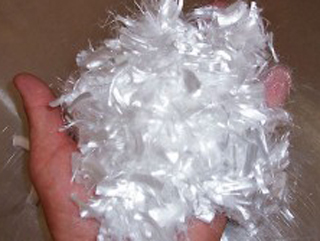
Spray-up GFRC Fibers

Coming soon: A more in depth look at GFRC mix designs, casting, thickness, curing and processing.

Quick Facts About GFRC

  • GFRC was first created in the 1940s in Russia, but it wasn’t until the 1970’s that the current form came into widespread use.
  • GFRC tends to run about $2.50-$3.00 per square foot for ¾” thick material. The cost increases to about $3.50-$3.75 per square foot for 1” thick material when accounting for the prices of sand, cement, admixtures, fibers and polymer.
  • Just like regular concrete, GFRC can accommodate a variety of artistic embellishments including acid staining, dying, integral pigmentation, decorative aggregates, veining and more. It can also be etched, polished, sandblasted and stenciled. If you can imagine it, you can do it, making GFRC a great option for creating concrete countertops and especially three-dimensional concrete elements.

To learn more about GFRC check out these great articles on our blog:

The importance of water/cement ratio in concrete countertop mix design

Three simple ingredients can be blended and proportioned numerous ways to make concrete:

  • aggregate
  • cement
  • water

In concrete, the single most significant influence on most or all of the properties is the amount of water used in the mix.

In concrete mix design, the ratio of the amount of water to the amount of cement used (both by weight) is called the water to cement ratio (w/c). These two ingredients are responsible for binding everything together.

The water to cement ratio largely determines the strength and durability of the concrete when it is cured properly. The w/c ratio refers to the ratio of the weights of water and cement used in the concrete mix. A w/c ratio of 0.4 means that for every 100 lbs of cement used in the concrete, 40 lbs of water is added.

Typical w/c ratios are as follows:

  • Normal for ordinary concrete (sidewalks and driveways): 0.6 to 0.7 
  • Specified if a higher quality concrete is desired: 0.4

The practical range of the w/c ratio is from about 0.3 to over 0.8.

  • A ratio of 0.3 is very stiff (unless superplasticizers are used).
  • A ratio of 0.8 makes a wet and fairly weak concrete.

Typical compressive strengths when concrete is properly cured are:

  • 0.4 w/c ratio –> 5600 psi
  • 0.8 w/c ratio –> 2000 psi.

The simplest way to think about the w/c ratio is to think that the greater the amount of water in a concrete mix, the more dilute the cement paste will be. This not only affects the compressive strength, it also affects the tensile and flexural strengths, the porosity, the shrinkage and the color.

The strength is reduced mostly because adding more water creates a diluted paste that is weaker. Think of it like over-diluting grape Kool-Aid. The more water you add, the weaker the Kool-Aid is.

grape koolaid

Explained more technically, more water results in larger spacing of the cement particles. As the crystals grow, they are too far apart to knit together and form strong bonds.

cement particles

Concrete with a higher w/c ratio is also more susceptible to cracking and shrinkage. Shrinkage leads to micro-cracks, which are zones of weakness. Once the fresh concrete is placed, excess water is squeezed out of the paste by the weight of the aggregate and the cement paste itself. When there is a large excess of water, that water bleeds out onto the surface. The micro channels and passages that were created inside the concrete to allow that water to flow become weak zones and micro-cracks.

Using a low w/c ratio is the usual way to achieve a high strength and high quality concrete, but it does not guarantee that the resulting concrete is always appropriate for concrete countertops. Unless the aggregate gradation and proportion are balanced with the correct amount of cement paste, excessive shrinkage, cracking and curling can result. Good concrete results from good mix design, and a low w/c ratio is just one part of a good mix design.

Concrete technology from early 1900s still applies today

Scientific American magazine has a section called “50, 100 & 150 Years Ago” that features blurbs from the magazine in each of those years. Here is a recent entry for March 1911:

“Concrete for Construction”

“About fifteen years ago serious attempts were made to combine steel and concrete by moulding one into the other in such a way that the resulting product would possess a high resistance not merely to compressive but to bending and tensional stresses. A vast amount of experimental work was done, out of which has sprung our modern reinforced concrete. Not only is concrete found to be available for practically every form of construction which hitherto has been built in brick and stone, but it has now invaded the field which was supposed to be peculiarly reserved for iron and steel.”

If you’ve seen my free video about reinforcing concrete countertops, you know exactly what these compressive, bending (flexural) and tensional stresses are! And you know that your concrete countertop construction methods are based on sound scientific principles. What’s surprising is how recently reinforced concrete was invented, seeing as concrete has been used since Roman times.

The best mix design for concrete countertops

Whether you use a bagged mix specifically designed for concrete countertops, or mix your own, mix design is critical for concrete countertops. Unlike sidewalks or foundations which are slabs on grade, concrete countertops are generally long, slender, thin beams that not only behave very differently structurally from slabs on grade but also have very different aesthetic requirements. For example, color is not an important consideration in structural concrete mix design, but it is in concrete countertop mix design.

Before we get into mix design considerations, note that you can either use a bagged mix specifically designed for concrete countertops, or mix your own from scratch. Our preference at CCI is for mixing your own, since Jeff is an engineer as well as a thrifty Yankee. However, there are pros and cons to both approaches. (More on that in another blog entry.) We do believe that even if you choose to use a bagged mix in your business, you should fully understand how concrete really works, so that you are better able to troubleshoot or adjust for your climate and working conditions.

What you need from a concrete countertop mix:

  • High early strength so you can process and finish faster
  • High flexural strength for greater crack resistance
  • Low shrinkage potential which minimizes curling
precast mix design


High Early (Compressive) Strength
Jeff is always saying, “Compressive strength is not as important as you think.” However, high early strength is important early on when you need to get the concrete out of the forms, flip it over and start grinding it as soon as possible to get it into your client’s home. Concrete that develops high compressive strength quickly is going to be harder than concrete that develops strength more slowly. This means that the cement paste between the hard sand grains and aggregate will be harder, and the concrete can be ground and polished sooner.

High early strength is accomplished by using a low water to cement ratio, proper pozzolan loading and cement contents higher than construction grade concrete.

High Flexural Strength
Steel reinforcing is still essential, since the flexural strength of concrete is always much, much lower than the compressive strength. For example, the predicted value of flexural strength for ordinary construction concrete that has a very high compressive strength of 12,000 psi is only about 900 psi! But, if the flexural strength of your concrete is as high as possible, it is going to better withstand bending (flexural) forces along with the steel reinforcement, and show less cracking.

High flexural strength is achieved through both mix design and proper reinforcement. Steel reinforcing effectively boosts flexural strength values many times that of unreinforced concrete. GFRC uses a special mix design and high glass fiber loads that create high flexural strength.

Low Shrinkage Potential
Shrinkage can cause either cracking for restrained slabs or curling for unrestrained slabs. Shrinkage occurs when the cement paste dries out. Moisture evaporating from inside the concrete causes strong capillary suction forces in the cement paste that cause it to shrink. If the shrinkage forces are high enough, the concrete cracks. The underlying causes of this can be poor curing practices (allowing the concrete to dry out too soon before it’s strong enough to resist the suction forces), too much mix water, too much cement in the mix, or poor aggregate gradation that requires too much cement paste to achieve good workability.

Curling occurs when one face of a countertop shrinks more than the other side, and the result is that the countertop curls towards the side that shrank more. Curling can occur if one side of the slab remains wet and the other side is dry. Curling is a symptom of shrinkage. Concrete mixes that don’t exhibit significant amounts of shrinkage don’t curl much or at all.

Shrinkage reducing admixtures (SRA’s) are chemicals that reduce the suction forces generated during evaporation. This helps reduce the root cause of cracking and curling: the suction forces in the cement paste.

There are many different styles of concrete countertop mixes:

  • all-sand mixes designed to be stiff and hand packed
  • aggregate-based mixes designed for vibration or cast in place
  • polymer-based mixes that flow like pancake batter
  • GFRC mixes

Regardless of the style of mix, the basic principles discussed above apply.

Stiff mix, all sand

stiff concrete countertop mix

Flowable mix, aggregate based

fluid concrete countertop mix


More Details
Want to know more? Both of the above from-scratch mix designs, as well as a handy mix calculator, are included in our Precast Mix Design 101 self-study course. Questions about this article? Submit a comment below. And happy concrete mixing!

precast mix design2

Fibers as Secondary Reinforcement in concrete countertops

Fibers are used in concrete for a variety of reasons, and not all fibers do the same thing or have the same effect on concrete. The size, shape, material and amount of fibers used has a significant effect on the concrete, and using too little or the wrong fiber type can result in disappointment or failure.

Fibers are generally added to concrete as shrinkage control (also known as secondary reinforcement; structural reinforcement is primary reinforcement). As the concrete sets and transforms from a workable paste into a hard solid, plastic shrinkage can occur. This is especially true in concrete slabs exposed to heat or wind. The matrix of fibers helps to stabilize the wet concrete and distribute the shrinkage stresses so that large cracks are minimized or eliminated.

Fibers are often advertised as capable of replacing welded wire mesh. This is true, but only when the welded wire mesh is used only as plastic shrinkage control. The confusion stems from the fact that welded wire mesh can also be used as structural (primary) reinforcement, while synthetic fibers cannot.

Most commonly used fibers are synthetic, either polypropylene or nylon, but some are natural, like cellulose fibers. None of these fiber materials is stiff or strong enough to provide any significant tensile reinforcement to uncracked concrete. And they simply stretch too much to do any good once the concrete cracks. After the concrete hardens, these fibers don’t contribute anything (nor can they) to resisting external structural tensile stresses.

There is a class of fibers that provides some resistance to external structural tensile stresses, but these are more esoteric and not generally necessary if you use proper steel primary reinforcing.

This information applies to precast concrete countertops, not to GFRC concrete countertops (glass fiber reinforced concrete). In the case of GFRC, fibers do provide the primary reinforcing because there are so many of them, they are aligned two-dimensionally by rolling, and there is enough polymer in the concrete to provide a great deal more flexibility than normal concrete. Be aware though, GFRC is a system. You cannot take one element of GFRC and add it to regular precast concrete countertops and expect it to convey the properties of GFRC to the countertops.

Structural AR glass fibers in GFRC:Fibers in GFRC

Rebar size in Concrete Countertops: It can be too big.

The size of reinforcing steel in a countertop is an important consideration. Concrete countertops that are made with rebar that is too large in scale for the slab thickness are susceptible to telegraph cracking.

When concrete shrinks due to drying out, high tensile stress levels develop around proportionally oversized reinforcing. These stresses cause cracks that run along the length of the steel. Smaller diameter reinforcing has less of an affect on the concrete, so the same amount of concrete shrinkage develops much less tensile forces, thus the likelihood of cracks caused by the steel itself drops dramatically. Because all concrete shrinks to some degree, and shrinkage occurs over a long period of time, the occurrence of telegraph cracking may not appear until long after a countertop is installed.

In addition, oversized reinforcing occupies so much space inside a thin countertop slab that there is very little cover between the steel and the slab surface. Generally, reinforcing is fabricated in a grid arrangement, with strands running along the length of the slab and overlapped strands running across the width of the slab. When stacked, larger rebar can take up half of the total slab thickness, while smaller rebar takes up much less space.

 Oversized rebar can cause telegraph cracking

The sheer size of rebar that is too big places a significant amount of the steel closer to the visible surface of the countertop instead of down near the bottom of the slab. For example, a grid made from 3/8” diameter rebar held only 1/4” away from the bottom (the bare minimum cover for such a size) would place the top of the rebar at the midpoint of the slab, leaving only 1/2” of concrete cover between the steel and the visible surface. Contrast this with a grid made from 3/16” diameter wire held ¼” away from the bottom of the slab, and now there is 7/8” of concrete between the surface and the steel, a 75% increase in cover.

In addition to causing large stress concentrations in the concrete (and therefore increasing the likelihood of telegraph cracking), using oversized reinforcing actually decreases the load capacity of the concrete.

In the drawing above, the same concrete is reinforced with equal amounts of steel reinforcing (based on cross sectional area). The top drawing shows one piece of 3/8” (#3) diameter reinforcing steel while the bottom drawing shows four pieces of 3/16” structural reinforcing wire. The cross sectional areas are the same, so the tensile capacity of the steel is the same.

But because the four pieces of wire can be located lower in the slab, the load capacity of the wire-reinforced concrete is now 13% (lower reinforcing layer) to 78% (upper reinforcing layer) greater than the slab with the single #3 rebar, even though there is the same amount of steel in the concrete. In actuality, the structural wire has a higher strength than the rebar, so the difference in capacity is even greater.

Are concrete countertops still at risk of cracking if they have high compressive strength?

“My concrete has a high compressive strength. That means I don’t need reinforcing to protect against, right?”

Not necessarily, and not in all circumstances. All concrete, regardless of the mix design or the magnitude of the compressive strength, is much weaker in tension than in compression. And cracks are caused by tensile failures of the concrete.

The tensile strength of concrete is often only about 10% that of the compressive strength, but this is a rough average. Tensile strength is highly variable, difficult to predict, and is dependent not only on the ingredients and their proportions, but on the casting technique, the curing history, the amount, size and distribution of voids and defects (microcracks), etc. Even the amount of pigment or other admixtures can significantly reduce the tensile strength of the concrete.

Unreinforced countertops rely completely on the tensile strength of the concrete itself to hold everything together. Since it is already known that the tensile strength is variable and difficult to predict, relying solely on it is tantamount to gambling with a finished piece.

Often experimenters will initially try out small pieces with success, because small pieces don’t develop large tensile stresses when handled. However, success leads to bolder ventures, and longer slabs result. Eventually the sheer weight and size of the slab generate tensile stresses that overcome the concrete. Because there is no reinforcement to resist the tensile load after the concrete cracks, the slab suddenly fails and snaps in half with little or no warning.

Reinforcing steel adds ductility, the ability for a material to absorb deflection and overloading without falling apart. Unreinforced concrete fails in a brittle fashion. That is, it fails suddenly and without warning; one moment it’s fine, the next it’s broken. Don’t take these kinds of risks with your concrete countertops.

Compression/Tension: Concrete countertops are beams

A beam is a horizontal structural member that spans some open space and is supported near the ends. The beam can then support some weight placed on top of it somewhere between the end supports. A floor joist is a beam. Concrete countertops are also beams.

When a beam has weight placed on top of it, that weight causes the beam to deflect (bend). Small weights on stiff beams cause almost no deflection, while large weights on flexible beams cause significant deflection. The deflection in the beam causes two things to happen: The top surface of the beam is compressed and tries to get shorter, and the bottom surface is in tension and tries to get longer.

Between the two something important occurs. Compression is the opposite of tension, so as one progresses down the beam from the top surface to the bottom, the compression stress gradually decreases to zero and then the stresses reverse, go into tension and gradually increase towards the bottom of the beam. If an unreinforced beam has a symmetrical cross-section (like a rectangle), the stress switch occurs at the midpoint between the upper and lower faces. This is important because given that there is no tension or compression stress at the midpoint of a countertop, placing reinforcing steel there does absolutely no good. The point at which this switch occurs is called the neutral axis, and can be thought of as an imaginary line that runs parallel to the length of the beam.

compression-tension in beam

If a countertop is made out of concrete (with no reinforcement), any significant weight placed on top of it will cause it to fail at the bottom of the countertop because the tension stresses in the bottom of the countertop will exceed the tensile strength of the concrete. A crack will form at the bottom and progress upward literally at the speed of sound.

Some argue that because concrete countertops usually actually span only the width of a cabinet box (usually a maximum of 36″), they are rather short beams, and therefore the stresses involved are not that high. This is true, but what about when an 8 foot long precast slab is picked up in the shop and loaded onto a truck for transportation? The largest stresses and biggest risk of cracking occur in the shop. Once the slabs are installed, only settling of the cabinets or building would impart much stress.

This video goes much more in depth on the subject of compression and tension forces in concrete countertops.

Good concrete countertop mix design for cast in place

Key characteristics that define a good cast-in-place concrete countertop mix are finishability and shrinkage resistance. However, these two characteristics are at odds with each other and must be carefully balanced in order to produce a good cast in place concrete countertop mix that is a joy to finish and does not curl or crack.

Other beneficial characteristics worth mentioning include workability and flexural strength. While high compressive strength is not necessary (though it is impressive), high quality concrete, often a byproduct of creating a high compressive strength mix, is also beneficial and desireable. Additionally, adequate work time, high early strength and a good appearance add to the list of desireable characteristics.

The two key characteristics that are very important, finishability and shrinkage resistance, are often determined by the aggregate gradation and the cement to aggregate proportioning.

Finishability, that is, the ease of trowelling the concrete into a smooth, even, high-quality surface relies on a sufficient amount of cement paste and very fine aggregate to create enough cream to trowel. Cream is the fine portion of concrete that is floated to the surface early in the casting process and is worked and reworked during trowelling.

Shrinkage resistance is also influenced by the water-cement ratio, by the cement paste content and by the amount of fine aggregate. Whereas finishability benefits from more cement paste and fine aggregate, shrinkage resistance benefits from less cement paste that has a lower water-cement ratio, since that is what actually shrinks. Minimizing the fine aggregate preserves workability when the cement paste volume is reduced, because fine aggregate (sand) has much more surface area than coarse aggregate, so more cement paste is needed to coat and separate fine sand than is required for a coarse blend of aggregates.

A poor cast in place concrete countertop mix would have large aggregate of one size, say 3/8″, mixed with fine sand. This is a case of “gap grading”. A good mix will have well-graded aggregate.

aggregate gradation in concrete countertop mix