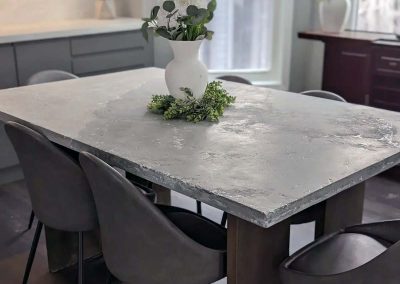
Using different mixes in a single concrete countertop slab

I recently got the following question regarding my blog post “Mix design for cast in place concrete countertop in Cayman“:

Q: Is it possible to use gray cement for the core and white cement as an outer layer?

White and gray portland cement are very similar to each other, and can be safely blended together. You can use one color cement for a core mix and a different color cement for a shell mix, provided the mix designs and the water/cement ratios are identical.

However, I would hesitate to use a gray cement core with a white cement “shell” for aesthetic reasons, especially for projects like the cast-in-place gazebo I did in Grand Cayman, and for regular precast “wet cast” projects. The simple reason is that it’s very impractical to pour a core mix without contaminating the form surfaces, contain the core mix so that it stays where you want it, and to pour the visible shell mix and still end up making good concrete without voids or weak zones. The minor cost savings in cement (white cement in Cayman is about US$20 per bag, vs gray cement at US$10 per bag).

The exception is when an ultra-expensive pigment is involved. In that case it is sometimes worthwhile in cost savings to take the extra trouble to use the pigment only in the outer layer.  I call this “buttering”. It is easier to do with a hand packed precast method, somewhat easy with GFRC, and hardest with wet cast precast or cast in place. Be aware, however, that some exotic pigments could affect the properties of the mix to the extent that you have issues with the 2 layers bonding.

Tips for “buttering”:

  • The first layer should be well compacted, of even thickness and fairly smooth. Loose, clumpy or uneven concrete will create weak zones that could lead to cracking or delamination.
  • The second batch of concrete should be the identical mix (but without glass or stone if used in the first mix).
  • It’s very important to use the same water content, and merely add more superplasticizer to make the second batch more workable.
  • It’s important to place the second batch before the first becomes hard or dries out.

For the gazebo job I did in Grand Cayman (8000 lbs of concrete), the extra price from using all white cement added up to only about an extra $100 in cost. Consider the need for 2 separate mixers, the extra labor and time needed to wrangle two mixes, and it’s easy to see that at times it’s simpler to bite the bullet and pay a bit more up front to make things simpler, and in the end, better and less expensive overall.

Here’s an example of a GFRC piece done with red outer shell (mist coat) and white core (backer). This was done just for illustration purposes. You can see in the second photo that some of the white showed through when the mist coat chipped.

gfrc red mist white backer

gfrc chip in mist coat

Color enhancement in concrete countertop sealers

I recently got a question regarding my article “Deciding on an outdoor concrete countertop sealer in Grand Cayman“:

“You never mentioned if the ‘pop’ in color is the same as a dry vs. wet look. I’ve applied sealers and although they looked matte, they still made the concrete look darker than before sealer is applied. Will this method [Stonelok 2K] change color?”

When a sealer “pops” the color of the concrete, it’s making the color seem richer, darker and more vivid. This is similar to what water does when it wets out the surface of concrete. A dry piece of concrete often looks very light, dull and lifeless. But when you wet it with water or seal it with certain sealers, the concrete comes to life, the color is truer and more vivid. This is all because of the way the sealer (or water) helps visible light reflect off the concrete.

Dry concrete scatters a lot of white light, so most of the light shining on it is scattered. The result: the concrete looks pale and lifeless.

light reflection rough

Wet concrete, polished concrete and concrete sealed with certain sealers reflects more of the light as colored light (the color of the concrete) and has less white light scattering. That’s why the concrete looks richer and more colorful.

light reflection wet surface

“Wet-look” sealers are sealers that make the concrete look like it’s wet with water. They pop the color and are typically very glossy. Not all finishes that pop the color make the concrete glossy. But high gloss finishes give the “wettest” look because of the combination of gloss and low white light scatter.

All sealers will affect the depth of color somewhat, although some waterbased acrylic sealers do very little to deepen the color. In effect they are the opposite of wet look sealers. Though the surface might be shiny from the acrylic, the color of the concrete still looks pale as if it were dry and unsealed. Every sealer is different, so you have to test the sealer to see whether its effect on the concrete’s color depth is what you want.

Stonelok E3 is a water-based epoxy that is used as a primer under Stonelok 2K (a waterbased urethane). E3 pops the color and is glossy. It’s not used as a sealer because it scratches too easily. Its job is to pop the color and to enhance the bond between the concrete and 2K. Stonelok 2K (the extra low gloss version I used) still pops the color a little bit, but not nearly as much as E3 does. The small amount of pop was acceptable to me and my client. I did test the E3 on a sample and didn’t like how it looked. That’s why I didn’t use it.

Thanks for the question Paul, and I hope that helps.

(I also covered this topic in a recent article for Concrete Decor Magazine.)

Coloring Techniques for Concrete Countertops: Part 3 of 3 – Dyes

Dyes

The third method for coloring concrete countertops is by using dyes. Dyes, like acid stains, are applied to cured concrete, and they can be applied over integrally pigmented and acid stained concrete. Unlike acid stains, dyes are not reactive. Dyes are ultra fine particles of color in some kind of liquid carrier, most often water or solvent, such as acetone.

The ultra fine particles “stain” the surface while the liquid carrier quickly evaporates, leaving very little or no residue. This quick evaporation (especially with the solvent based dyes) can be both a benefit and a drawback. Most often they are sprayed on, but they can be brushed, rolled or wiped on. Brushing, rolling or wiping a quickly evaporating dye will almost always lead to streaks or blotching, so spraying is generally used to ensure an even coloration.

Dyes can provide a wide range of colors, from duplicating the colors of acid stains to rivaling the colors of integral pigments. Rich, vibrant colors are possible with dyes, and because they can be diluted, mixed and layered, the color possibilities are nearly endless. Like acid stains, dyes are slightly translucent. The finished color is dependent on both the color of the acid stain and the color of the underlying concrete.

While dyes provide great versatility, especially when used as an accent or an easy means of coloring specific areas or designs in the concrete, dyes can be limited to where they can be used. Not all dyes are UV stable, and some must be used under sealers that block UV light. Water based dyes tend to be less UV stable and can bleed or smear if a water based sealer is applied over them. Solvent based dyes tend to be more UV stable (but always check with the manufacturer to find where and when to use them), and these too can bleed or smear if a solvent based sealer is applied to them. And like acid stains, dyes only color the surface of the concrete. Their beauty is only skin deep.

A significant advantage that dyes have over acid stains is that because dyes are not reactive, there is no residue to clean up after the dye is applied. This means that they can be sealed almost immediately after application (once the liquid carrier evaporates), making the project faster.

And finally, like acid stains, dyes can be very cost effective because a little goes a long way, but again the skill does not come cheap. Dyes are often used by highly skilled artists to create stunning works of art on concrete.

Several photos and more information about dyes are available at http://www.concretenetwork.com/concrete/concrete_dyes.

Conclusion

If you are a homeowner who wants a unique countertop, talk to your local craftsman about the types of coloring options he or she provides.

Whatever look you want to achieve, it is possible with the myriad coloring options for concrete countertops.

Coloring Techniques for Concrete Countertops: Part 2 of 3 – Acid Stains

Acid Stains

Acid stains are another very common and effective way to color concrete. Like integral pigments, acid stains are permanent and most can be used inside and outside. Unlike integral pigments, acid stains are applied to the concrete only after it has cured. Integral pigments are used primarily because they are uniform and predictable. Acid stains are mostly used for exactly the opposite reasons.

Acid stains are chemical solutions that react with the concrete to form color. Each different acid stain contains a particular metallic salt that reacts with the calcium hydroxide in concrete; the acid makes the reaction possible.

Acid stains are reactive; for this reason, they are somewhat unpredictable, or as some people prefer to say, more spontaneous. While the color of the acid stain won’t vary much from what’s expected, the shade and intensity will. The intensity of the color is dependent on both the concrete and the acid stain. Since the acid stain reacts with the concrete, the age, ingredients, texture, curing method and finishing method (honed versus trowelled) all have a strong influence on the final result. And the stronger the acid stain solution (the less dilute it is) and the longer it is allowed to react with the concrete, the more intense the color will be. So the end result is a beautiful mottling of shades and intensities, where the exact end result cannot be predicted.

Acid stains come in a limited (but popular) range of colors. Browns, rusty reds, orangey-browns, bluish-greens and yellow-greens typify the colors commonly available. While the colors are generally the same or similar from manufacture to manufacturer, the strength of the acid may vary, and this influences the color. Acid stains are slightly translucent. The finished color is dependent on both the color of the acid stain and the color of the underlying concrete.

Acid stains form the color on the surface of the concrete. Smooth, dense, high quality concrete, which is very typical in concrete countertops, is not very porous. Acid stain color does not penetrate very far into the concrete. Typically it is only a few thousandths of an inch deep. Because of this the color can be worn off from prolonged abrasion, so some sort of sealer generally applied over the stain to protect it. This is more often a concern with floors than with countertops.

It is possible to mix some acid stains together, and it is possible to apply one color over the top of another acid stain. And acid stains can be applied over integrally pigmented concrete. This is a good method for getting the best of both worlds: achieving a particular color and overall evenness of tone but capturing some of the unpredictable mottling too.

Since acid stains are applied to cured concrete before it is sealed, only a small amount is needed to color a large amount of concrete. Typically a gallon of acid stain costs about $50 to $70, but will color several hundred square feet of concrete. This makes them very economical.

However, the skill involved in applying acid stains and knowing what effects will be achieved does not come cheap. It requires a great deal of experience and attention to detail. A craftsman who has experience in acid stained concrete floors is often a good candidate to apply his or her skill to acid staining concrete countertops.

Acid staining is also a popular technique in conjunction with stencils. Stains can be applied before and/or after stenciling to achieve a variety of effects.

 acid stained concrete - brown over copper with Modello stencil

Brown over copper with Modello stencil


Floral edge with amber acid stain

Traditional look achieved with amber acid stain and floral edge

Coloring Techniques for Concrete Countertops: Part 1 of 3 – Integral Pigments

There are three common methods for coloring concrete countertops. One way is by using integral pigments. Another way is to acid stain the concrete, and the third way is to use a dye. This article explains integral pigments.

Integral Pigments

Integral pigments are a very common method for coloring concrete. Pigments are very finely ground particles of inert colored material that are mixed into the concrete (usually during mixing, or sometimes during trowelling).

Integral pigments can be powders or liquids. They can be natural minerals, manufactured metal oxides or synthetic materials. Integral pigments offer the widest range of color options that span the entire spectrum. Pigments can be pure white, deep black, red, bright yellow, blue, purple, green, brown, orange, etc. Pigments can be blended into a nearly infinite range of shades and colors, offering virtually the same color range as the paint industry.

integral pigments

Integral pigments provide versatility and dependability. The strength of integral pigments is their huge color range and their consistency. Pigments are the most consistent and highly controlled ingredient in concrete. As long as careful batching, mixing and curing procedures are followed (paying special attention to controlling the mix water), the resulting color consistency can be very high. With integral pigments, it’s easy to achieve the same color and the same look over and over again, as long as the your concrete countertop craftsman is meticulous.

Integral pigments get mixed into the concrete, so the entire body of the concrete is colored (although there are methods that don’t require coloring all of the concrete in a slab). This means that significant quantities of pigment are required, and this leads to perhaps integral pigments’ downside. Some pigments are more expensive and harder to find. Pigment prices can range from $2/lb to over $60/lb, and while many of the standard iron oxide colors are widely available from a number of manufacturers, some of the more exotic colors are available from only a few small distributors. A concrete countertop craftman may charge more for concrete colored with some of the more exotic colors.

Here are a few pictures of concrete colors achieved with integral pigments.

Integral colors can be subtle:

sage green countertop

Soft sage green countertop


penny color with rustic edge

Penny colored countertop with rustic edge.


 Or bright:
turquoise embedded in bright red concrete

Piece of turquiose embedded in edge of bright red countertop


Aqua blue oyster bar with blue glass

Aqua blue oyster bar with blue glass


Or combined with other effects to create different looks. The following two countertops use a bit of black pigment to create a dark gray concrete, but then use stone and glass in different ways to create very different looks.

gracy concrete with stones

Traditional look achieved with gray concrete and cream/tan stones and traditional edge.


gray concrete with black grout and clear glass

Contemporary look achieved with gray concrete and black grout and clear glass.

Making a tie-dyed concrete countertop

As a fun follow-up to my Achieving Color Consistency series, I thought I’d post some photos of a crazy “tie-dyed” concrete table I made. You could use this technique with a concrete countertop and with any combination of colors.

The process was actually quite simple. I just used extra-bright synthetic pigments, some liquid and some powder, and mixed very small batches.

mixing tiny batch

colors

Once I had the colors ready, I applied them in a pattern to match a photograph.

starting swirls

adding colors

Then I poured bright white concrete over the whole thing.

adding white

The colors got a little smeared in the finished table, but I think it looks far-out and groovy, man!

finished table

Achieving color consistency in concrete countertops: Part 3 of 3

You have learned that water strongly affects the color of a concrete countertop mix, as does precision of measuring and measuring by weight, not volume. This final article in the color consistency series lists several other reasons you might encounter inconsistency in your concrete countertop mixes.

  • Variability in the ingredients themselves

From year to year, the ingredients you use can vary, even if you buy the same ingredient from the same manufacturer. Pigments tend to be very consistent, but cements, especially gray cements, are not. Your colors that have less pigment, and therefore obtain most of their color from the cement, will exhibit more variability thann heavily pigmented colors.

  • Use of pozzolans

You may use pozzolans such as metakaolin, VCAS, fly ash, slag or silica fume in your mixes. Some of these pozzolans, especially waste products such as slag, can be highly variable in color. And, pozzolans such as silica fume can impart a very distinct color to the concrete. Besides the fact that different pozzolans have different actions and properties, you should not vary which pozzolans you use in your mix designs if you want to achieve color consistency.

pozzolans

Various pozzolans. Photo courtesy www.cement.org

  • Use of admixtures such as superplasticizer

Admixtures like superplasticizers can influence color, not because they add color, but because they can act like dispersants, aiding in cement and pigment dispersion and the resulting color strength. Other admixtures usually have little effect on the color, like fibers, accelerators or retarders, however calcium chloride accelerators are an exception and should be avoided for this and other reasons.

  • Not blending ingredients thoroughly

Thorough and complete blending of all of the concrete ingredients is very important to achieving a uniform and consistent color. All of the pigment added to the mixer should be uniformly blended. If pigment is stuck to the sides of the mixer or in lumps or streaks then the resulting concrete will not be consistent with other batches nor will the color of that batch be uniform.

  • Adding liquid pigment to the mix water

Adding liquid pigment to the mix water before adding the now pigmented mix water to the concrete can cause color inconsistency because a significant amount of the pigment usually remains in the bucket.

Liquid pigments are really ultra fine pigment particles suspended in a liquid. If the liquid pigment is added to mix water, the pigment particles will quickly settle out because the suspension fluid is now greatly diluted by the mix water. No amount of stirring will suspend all of the pigment particles, so much of the color remains in the bucket rather than going into the mixer.

When done carefully, it is possible to add the liquid pigment to a portion of the mix water and then use the remaining mix water to rinse out any pigment residue.  But this involves extra work and requires extra attention. A simpler process would be to add the liquid pigment directly to the mixer and then to rinse out the pigment container with the mix water as it is added.

  • Inconsistent curing practices

Curing the concrete has an effect on concrete color. Curing the concrete after casting helps “lock in” the color. If some slabs are allowed to wet cure for longer than others, the slabs that dry out sooner will appear lighter.

  • Forms

Forms for fluid concrete mixes must be watertight in order to achieve consistent colors. Otherwise, color variations will show where some of the concrete leaked out of the forms. Form materials themselves (the texture and porosity) can affect the color of the concrete too.

Conclusion

Everything that goes into making concrete has some effect on its appearance. Discipline, attention to detail and knowledge of good concrete practices will make your concrete countertops as consistent as possible.

Achieving color consistency in concrete countertops: Part 2 of 3

The last article talked about the importance of measuring ingredient precisely, especially water. It is also very important to understand that you must measure by weight, not by volume.

Suppose a mythical concrete countertop mix included cotton balls as one ingredient and golf balls as another. Clearly a much larger volume of cotton balls would be needed to make one pound, versus one pound of golf balls.

There are some ingredients which seem to have consistent weight-volume conversions, such as water. You know that one quart of water is 32 (fluid) ounces. So you could just measure your water using a container with ounce or quart markings on it, right?

Not so. Measuring containers are typically not designed to a high degree of precision. Watch this video to see why using measuring containers can lead to errors and inconsistency.

Achieving color consistency in concrete countertops: Part 1 of 3

Integrally colored concrete countertops can show color inconsistency for a variety of reasons, but the primary cause is lack of ingredient control: One or more of the ingredients in each batch of concrete were not carefully proportioned.

Most often the culprit is water. Adding too much water – often to increase the workability – will alter the color of the concrete, making it lighter than a similar batch that has less water in it.

Think of grape Kool-Aid. The more water you add, the lighter the color will be. The same applies to concrete. (The concrete will also be weaker, just like the Kool-Aid will taste weaker.)

Kool-Aid

Remember, water is the most critical ingredient in concrete, and casually adding water without keeping track of the exact amount will almost guarantee an inconsistent appearance. To ensure color consistency, ALL of the ingredients, including water, must be accounted for.

The simplest way of doing this is to generate a batch report, where each ingredient amount is listed next to a check box. The batch report ensures consistency in ingredient amounts, and the check boxes ensure that none of the ingredients gets left out.

The CCI mix calculators, both the Precast Concrete Countertop Mix Calculator and the GFRC Concrete Countertop Mix Calculator, print out batch reports. Whatever method you use to calculate your mix, make sure that you are diligent about using batch reports.

Types of integral pigments used in concrete countertops

Concrete can be colored in a variety of ways, including using acid staining, dyes, colored aggregates, cement and integral pigments. This article explains the various types on integral pigments commonly used in concrete countertops.

Integral pigments are very finely ground inert particles that are mixed into concrete to change its color. Integral pigments can be dry powders or liquids, which really are liquid suspensions of solid particles (much like paint). Pigments are dosed like other admixture ingredients, based on the total cementitous material weight. Dosages can range from 0.1% to 10% (the maximum recommended dosage), but typically the range is narrower, from 0.5% to 5%.

Concrete is a harsh environment for pigments. It is wet, very alkaline and can be exposed to heat and ultraviolet light (from sunlight). This harsh environment can break down some pigments that cannot resist such attacks. This is why it is very important to use pigments designed for use in concrete. A vibrant blue pigment intended for the paint industry may not last long in concrete unless it can completely resist the concrete.

Pigments come in a wide range of colors.

  • Basic iron oxide pigments are the most widely used and are readily available, and they tend to be inexpensive. These are the basic “earth tone” colors: browns, reds, blacks and dirty yellows. Prices generally range from $2 to $6 per pound.
  • Special metal oxides provide other colors: some iron oxides are purply red, blue or yellow; chromium oxide is green, and titanium oxide is bright white. These are generally a bit more expensive, ranging from about $4 to $20 per pound, and true cobalt blue is much more expensive.
  • Synthetic pigments are generally even more expensive but provide the vibrant colors unobtainable from metal oxides. Brilliant violet, pure red and canary yellow are all available. Less expensive versions of expensive natural pigments (like cobalt blue) can make even some colors affordable. Synthetic pigments tend to be more powerful than iron oxides, so less is needed to get the full depth of color. Prices range from $20 to $75 per pound.

Pigments for concrete countertops

Powdered pigments are often sold in bags or cans, and can either be loose or granulated. Granulated pigments are marketed as “dustless” because the fine pigment particles are bound together with a water soluble binder. Granulated pigments are designed for use in mixer trucks where the coarse aggregate and lengthy, vigorous mixing action break the particles up. Some concrete countertop fabricators have noticed inefficient mixing and color streaking because the granules don’t completely break up.

Liquid pigments are solid pigment particles suspended in a liquid. The liquid helps to keep the pigment suspended for the duration of the measuring and dosing. Liquid pigments should be well mixed before dosing, because the pigment particles settle out. Pigment concentrations vary depending on the color or manufacturer.

Lastly, some pigments, especially some liquid and synthetic pigments, have water reducing or even superplasticizing characteristics. And some also have a mild retarding affect. It is important to try out a new pigment to see how it affects the concrete before using it for a paying client’s project.

Adding decorative aggregate to concrete countertops

Decorative aggregates, whether they are colored glass, crushed stone or other materials, can create interest and add pizzazz to a concrete countertop. This is one of the easiest and most fun ways to create an exciting custom look for your client. You can use recycled glass, elements of the room such as glass tile pieces, or even the client’s own mementos such as a broken vase.

There are two basic ways of getting the decorative aggregate into the concrete countertop:

  • Method 1: Mix all of the decorative aggregate in with the concrete
  • Method 2: “Seeding” or place the aggregate into the empty forms before the concrete is placed.

Both methods can be used together, and each has its pros and cons.

Mixing the aggregate into the concrete before casting is an easy way to achieve consistency, control and uniformity.

Since the decorative aggregate is mixed into the concrete, all surfaces will look the same. In addition, the average spacing of the aggregates is more uniform.

Because the total amount of ingredients is known, duplication of the concrete is easy. Varying degrees of exposure are controlled by altering the amounts (weights) of decorative aggregates used and the sizes of the aggregate particles. Larger aggregates have fewer particles per pound, so the overall coverage looks lower than with smaller aggregates.

The biggest disadvantage to this method lies in the amount of aggregate required. Only a small fraction of the decorative aggregate is actually exposed. Most of the aggregate never is seen, and this can significantly increase material costs.

Additionally, mix design adjustments may be necessary depending on the size and amount of decorative aggregate used. Large amounts of aggregate might call for substituting some of the other ordinary aggregate for some or all of the decorative aggregate, and it also might require a change in cement paste content or consistency.

However, if cost is not an issue and the client wants a random but uniform look, this is the easiest method.

To summarize, advantages are:

  • More uniform spacing
  • Easier to duplicate a random look
  • Easy to do

Disadvantages:

  • May be costly because more aggregate must be used
  • May require mix design adjustment

Pre-placing the decorative aggregate into the forms is an alternative method that uses much less material. This method is very useful when the decorative aggregate is very expensive, only a small amount is available or specific patterns or locations of aggregates are desired. Sometimes aggregate is glued to the forms to prevent shifting, although this works best with larger pieces that have a distinct flat gluing surface.

preplacing aggregate

Disadvantages include the tendency for scattered aggregates to shift, move or get lost during casting. Also, edges and vertical surfaces are difficult to seed so that they match the surface.

Replicating the look of random, scattered aggregates can be tricky too, since the effects of concrete placement and consistency can have a strong influence on the final appearance.

Advantages:

  • Uses less aggregate
  • Allows for specific patterns or locations of aggregate

Disadvantages:

  • Aggregate can shift or get lost during casting
  • Hard to match edges
  • Random look hard to replicate

Either method will require some degree of grinding to expose the embedded decorative aggregate. Larger, more rounded aggregates require the most grinding in order to expose some significant portion of their cross section. Small, angular particles take the least amount of grinding to expose.