Glow in the dark concrete countertops in the Cayman Islands

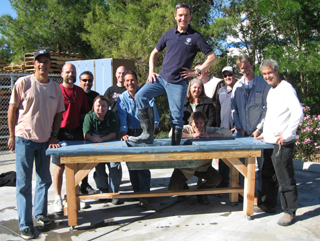
In July, I traveled once more to Grand Cayman to help my student Terry Wilson with a cool project. This was a 190 sq ft concrete bartop for the new Georgetown Yacht Club. It incorporated recycled glass (beer bottles), sliced coral and conch shells and glow in the dark aggregate!

The owner wanted to use sustainable materials, and he had heard several years ago about concrete countertops and how recycled glass can be incorporated into them. For the past 2 years, he has been saving every beer bottle he and his friends drank. He built his own concrete countertops for his office reception area and the washrooms for the marina. They look really great for a do-it-yourselfer! He showed me the countertops as an example of the look he was going for.

One of the DIY bathroom countertops

The client pointing out glass pieces he liked

He wanted to use glow in the dark aggregate to create a special effect and also to cut down on lighting energy. I advised using Glow Stone from Ambient Glow Technology, as it has the best luminosity and is available in a variety of colors and sizes. He had obtained some samples from another company (at exorbitant prices!); you will see later the clear difference in luminosity.

The client selecting Glowstone color and size

It REALLY glows!

The owner decided on 3/4″ Glow Stone in all 3 colors. The next order of business was to slice the coral and conch shells (easily available on the island) and to break up the beer bottles. There were 27 cases! Breaking them was not as easy as you might think. We had to crush them in small batches in a box, using a cast iron tamper.

Crushing beer bottles

Coral and conch slices ready to go

We used beach sand from nearby, and for the pozzolan used Bottle-Pozz 100% post-consumer recycled content from Fishstone. We also used every bag of white cement on the island! When Terry told me about the project, I told him to buy up every bag of white cement he could find, because I know from last summer how long it can take to get supplies onto the island.

Pour day went great. The pour was about 3 yards. We used ice to retard the mix. It’s always about 88 degrees (31 C) in Grand Cayman.

Adding ingredients to the truck

Ice to cool and retard the concrete

The concrete truck arrives

Screeding

After screeding, we seeded the top with all the decorative aggregate and accents and screeded it in. This was a harsh mix! In the photo below, the section in the back has been floated, and the section in the front has not yet been.

Floating

The next day, we started grinding the concrete countertops to expose the recycled glass aggregate and other decorative features. At 1 day, the compressive strength was already 2150 PSI. The 3-day strength tested at 3730 PSI, and at 7 days it was 6750 PSI. Not the strongest concrete I’ve ever made, but as you know from other blog entries, compressive strength is not the most important property.

Terry grinding the edges

Hot, gritty and sweaty

All the grinding, honing and polishing was very hard work, but it paid off. The client was thrilled, and the details in that bartop are amazing!

Finished bartop

Closeup of beer bottles

Closeup of conch shell

One section of the bartop

The Glow Stones looked amazing too. In the photo below, you can see some smaller stones from the client’s sample of the other “glowing” aggregate. They are much dimmer than the stones from Ambient Glow Technology!

Larger AGT Glow Stones contrast with other "glowing" aggregate

It glows!

In all, the project took about a week. The forms were built ahead of time. We poured on a Tuesday, spent Wednesday through Friday grinding, honing, grouting and polishing, and then Terry applied V-SEAL 101 that weekend.

I can’t wait to go back and see the finished yacht club and have a beer at this bartop!

For even more photos, see the album on the CCI Facebook page.


Superplasticizer in all-sand concrete countertop mixes

Recently I got the following question:

Question

I have been making concrete counters for a while, but I always have used mixes with aggregate in them. Recently, I started using sand based mixes. The water/cement ratio always ended up being more than desirable. I watched your video on superplasticizers, and although I used the max amount of CounterFlo (by Fritz-Pak), the .34 to 1 water to cement ratio I used produced a really stiff mix. We ended up adding a lot more water and the mix was still fairly stiff.

Here’s the video:

Answer

Sand mixes are very versatile mixes, in fact most of the countertops I’ve made over the last 12 years have been cast using an all-sand mix.

By their very nature sand mixes are best for stiffer, hand-packed finishes. They’re not the best choice when making a flowable mix due to the high surface area of the sand. Aggregate based mixes are best for flowable concrete.

With a good mix design that yields high early strengths it’s possible to hone the surface of an aggregate mix and not expose the aggregate. Usually it takes a great deal of effort to expose the aggregate, in large part due to the strength and flowability of the mix.

Getting an all sand mix to become flowable can be a challege, in part because of the type of superplasticizer required but more so due to the fact that sand has much more surface area than gravel does. 1 lb of sand has a lot more particle surface to cover with a fixed amount of cement paste than 1 lb of gravel, so there’s less cement paste separating the sand grains. That means there’s less lubricant, so more friction. That’s why you’ve always needed to add more water to your sand mixes.

When you add water you’re increasing the cement paste volume, thus increasing the particle spacing and adding lubricant. Adding extra water isn’t always bad, provided you know what the w/c ratio is and that it’s below a tolerable level. I’d recommend staying below 0.4.

Fritz-Pak’s Counterflo is a good water reducer, but it’s a very weak one. You’ll have a very hard time making flowable conrete with it. It’s not meant to do that, it’s simply a mild water reducer. It’s only meant to reduce the amount of water needed, not radically change the mix characteristics.

To make flowable concrete you need a powerful high range superplasticizer. My favorite is Optimum 380, a liquid polycarboxylate based superplasticizer sold by Fishstone (www.concretecountertopsupply.com).

Both my all-sand mix and my aggregate based mix are available in my self-study course Precast Mix Design 101.

Precast Mix Design 101

Mix design for cast in place concrete countertop in Cayman

I wrote recently about the planning stages for an outdoor gazebo bartop I’m doing here in the Cayman Islands. We’ve now poured the project, and I wanted to give you some insight into the mix we used and why.

This project required a large volume of concrete (nearly 8000 lbs, or 2 cubic yards), so I chose to have the local (and neighboring) concrete batch plant mix and deliver the concrete.

loading truck

However, the concrete was based on white portland, and I felt that a standard construction mix would have been too inferior for the demands of a high quality concrete countertop. Therefore I chose to modify one of the batch plant’s mixes to suit my needs. 

I spent some time with the plant’s engineer to learn more about their basic slab mix. Because the aggregates were local, I felt that using a mix that they had extensive experience with was smarter than trying to force fit an outside mix design that may or may not have worked the way I wanted it to. All I did was add a few admixtures to modify the base mix (and of course use white portland instead of gray portland). In addition to the base mix, I added Bottle Pozz (ultra fine ground glass bottles), a retarder, pigment and a shrinkage reducing admixture. I didn’t even need to use a superplasticizer, although we had one on hand if we needed to tweak the mix at the job.

Cast-in-place concrete needs special attention because it’s more difficult to control the environment during curing, and the concrete is exposed to greater environmental extremes (heat at least, but not cold here in Grand Cayman) than precast concrete used inside a home. Unlike sidewalks and floors, outdoor concrete countertops still have to look good and remain crack free.

I was casting a single slab over 45 feet long that wrapped around a hexagonal concrete gazebo. The thick concrete columns that hold up the roof penetrate the bartop, which wraps completely around each column. Crack control was very important, so I had to use a shrinkage reducing admixture to control the root cause of cracking, rather than hope fibers would do the job. I did not use fibers since ordinary fibers don’t prevent cracking anyway.

Here in the Caymans it gets hot, but not super hot. Average daily temperatures are 88 to 90 every day, all summer. It’s also very humid, which is a good thing, since the concrete doesn’t dry out as fast as when it’s hot and dry, like in a desert climate. To control early set I used a retarder, which gave me plenty of working time.

Although the truck delivered the concrete 10 feet from the job, it still had to be wheelbarrowed up to the bar and hand placed in buckets.

truck parked

The workability of the concrete was around a 4″ slump when we started, and it was unchanged when we finished pouring 2 hours later.

mix consistency

It took another 30 to 45 minutes to begin to firm up, but we left the job before it got to a hard trowel stage. Since we planned on grinding the concrete to expose the aggregate, all we did was screed and float in some decorative coarse aggregate and sliced coral into the top.

adding coral

For more photos of the project, view the entire photo album on the CCI Facebook page.

The role of aggregate in concrete countertop mix formulas

Aggregate in concrete is a structural filler, but its role is more important than what that simple statement implies. Aggregate occupies most of the volume of the concrete. It is the stuff that the cement paste coats and binds together. The composition, shape, and size of the aggregate all have significant impact on the workability, durability, strength, weight, and shrinkage of the concrete. Aggregate can also influence the appearance of the cast surface, which is an especially important consideration in concrete countertop mixes.

When selecting the most appropriate aggregate for a particular concrete mix, here are the key factors to consider:

Material

Most natural stones and crushed rock are appropriate for use in concrete. Commonly used stones are quartz, basalt, granite, marble, and limestone. If a concrete countertop is going to be ground with diamond tooling, the aggregate will show, so aesthetics also affect the choice of aggregates.

Problems arise with soft, reactive or weak stone or rock. Lightweight aggregates, a topic for another discussion, are also used in concrete.

Size

Aggregate size and gradation are the most important factors when selecting aggregate. Aggregate can be large or small, from fist-sized rocks to fine sand. Aggregates larger than ¼ inch are classified as coarse aggregate, while anything smaller than ¼ inch is termed fine aggregate. As a general rule, the largest aggregate should be no greater in diameter than one-third the depth of the slab, or one-fifth the smallest dimension of the form. For example, the largest piece of aggregate allowed for a 1 ½-inch-thick countertop slab is ½ inch. Generally coarse aggregate is blended with finer aggregates (such as sand) to fill in the spaces left between the large pieces and to “lock” the larger pieces together. This reduces the amount of cement paste required and decreases the amount of shrinkage that could occur.

Shape

Aggregate shape influences strength, but has more of an immediate impact on the workability of the plastic concrete. Rough, angular particles pack tighter, have more surface area, and have greater interparticle friction than smooth, rounded particles, which reduces workability. Angular particles also require a bit more cement paste to coat them than rounded particles. Therefore, mixes containing them will require a slightly higher cementitious content.

Gradation

In general, coarse aggregates tend to be about 10 times larger than the fine aggregates in concrete, but the range of sizes could be greater than that in certain circumstances. As shown in the figure, there are three typical range categories:

  • Well-graded aggregate has a gradation of particle sizes that fairly evenly spans the size from the finest to the coarsest. A slice of a core of well-graded aggregate concrete shows a packed field of many different particle sizes.
  • Poorly graded aggregate is characterized by small variations in size. This means that the particles pack together, leaving relatively large voids in the concrete.
  • Gap-graded aggregate consists of coarse aggregate particles that are similar in size but significantly different in size from the fine aggregate. A core slice of gap-graded concrete shows a field of fine aggregate interspersed with slightly isolated, large aggregate pieces embedded in the fine aggregate.  

Typical aggregate gradations are shown in the drawing below:

aggregate gradation

Poorly graded concretes generally require excessive amounts of cement paste to fill the voids, making them uneconomical. Gap-graded concretes fall in between well-graded and poorly graded in terms of performance and economy. Gap-graded concrete is a viable gradation, but not optimal.

Well-graded aggregates are tricky to proportion. The goal of aggregate proportioning and sizing is to maximize the volume of aggregate in the concrete (and thus minimize the volume of cement paste) while preserving strength, workability, and aesthetics. This balances the proportions of each so there are just enough of each size to fill all the voids, while preserving workability and cast-surface quality.

Note that aggregate gradation is particularly important in cast in place concrete countertop mixes. This blog entry explains further about cast in place mixes.

Mortar Concrete

Concrete made with just fine aggregate (or sand) is known as mortar concrete. Like the mortar used for brick and concrete block construction, which is simply made with mortar cement and sand, mortar concrete has no coarse aggregate in it, so a ground finish will have a fine-grained appearance. Mortar concrete is commonly used in concrete countertop mixes, since the surface finish is so important.

Even with an all-sand mix, aggregate gradation is still an important factor to consider and affects strength, workability, and aesthetics. It is always preferable to have some particle size variation rather than absolute uniformity because the interparticle void volume will be lower than with uniform particle sizes. While it is possible to blend different sands of different sizes together in a fashion similar to graded aggregates, generally only one type of sand is used. Most sand, especially bulk or bank-run sand, already has a particle size distribution that has some variation to it.

In order to achieve adequate workability, the cement paste volume must be high enough to encapsulate all of the aggregate particles and to provide some workability while the concrete is fresh. Therefore, mortar concrete tends to have a high cement content.

Conclusion

Aggregate gradation, whether in a mortar concrete or a traditional concrete mix, involves tradeoffs between strength and workability and is always a delicate balance. Understanding the implications of aggregate gradation is especially important when creating a from-scratch mix and will ultimately help you produce a better concrete countertop.

Adding decorative aggregate to concrete countertops

Decorative aggregates, whether they are colored glass, crushed stone or other materials, can create interest and add pizzazz to a concrete countertop. This is one of the easiest and most fun ways to create an exciting custom look for your client. You can use recycled glass, elements of the room such as glass tile pieces, or even the client’s own mementos such as a broken vase.

There are two basic ways of getting the decorative aggregate into the concrete countertop:

  • Method 1: Mix all of the decorative aggregate in with the concrete
  • Method 2: “Seeding” or place the aggregate into the empty forms before the concrete is placed.

Both methods can be used together, and each has its pros and cons.

Mixing the aggregate into the concrete before casting is an easy way to achieve consistency, control and uniformity.

Since the decorative aggregate is mixed into the concrete, all surfaces will look the same. In addition, the average spacing of the aggregates is more uniform.

Because the total amount of ingredients is known, duplication of the concrete is easy. Varying degrees of exposure are controlled by altering the amounts (weights) of decorative aggregates used and the sizes of the aggregate particles. Larger aggregates have fewer particles per pound, so the overall coverage looks lower than with smaller aggregates.

The biggest disadvantage to this method lies in the amount of aggregate required. Only a small fraction of the decorative aggregate is actually exposed. Most of the aggregate never is seen, and this can significantly increase material costs.

Additionally, mix design adjustments may be necessary depending on the size and amount of decorative aggregate used. Large amounts of aggregate might call for substituting some of the other ordinary aggregate for some or all of the decorative aggregate, and it also might require a change in cement paste content or consistency.

However, if cost is not an issue and the client wants a random but uniform look, this is the easiest method.

To summarize, advantages are:

  • More uniform spacing
  • Easier to duplicate a random look
  • Easy to do

Disadvantages:

  • May be costly because more aggregate must be used
  • May require mix design adjustment

Pre-placing the decorative aggregate into the forms is an alternative method that uses much less material. This method is very useful when the decorative aggregate is very expensive, only a small amount is available or specific patterns or locations of aggregates are desired. Sometimes aggregate is glued to the forms to prevent shifting, although this works best with larger pieces that have a distinct flat gluing surface.

preplacing aggregate

Disadvantages include the tendency for scattered aggregates to shift, move or get lost during casting. Also, edges and vertical surfaces are difficult to seed so that they match the surface.

Replicating the look of random, scattered aggregates can be tricky too, since the effects of concrete placement and consistency can have a strong influence on the final appearance.

Advantages:

  • Uses less aggregate
  • Allows for specific patterns or locations of aggregate

Disadvantages:

  • Aggregate can shift or get lost during casting
  • Hard to match edges
  • Random look hard to replicate

Either method will require some degree of grinding to expose the embedded decorative aggregate. Larger, more rounded aggregates require the most grinding in order to expose some significant portion of their cross section. Small, angular particles take the least amount of grinding to expose.

Good concrete countertop mix design for cast in place

Key characteristics that define a good cast-in-place concrete countertop mix are finishability and shrinkage resistance. However, these two characteristics are at odds with each other and must be carefully balanced in order to produce a good cast in place concrete countertop mix that is a joy to finish and does not curl or crack.

Other beneficial characteristics worth mentioning include workability and flexural strength. While high compressive strength is not necessary (though it is impressive), high quality concrete, often a byproduct of creating a high compressive strength mix, is also beneficial and desireable. Additionally, adequate work time, high early strength and a good appearance add to the list of desireable characteristics.

The two key characteristics that are very important, finishability and shrinkage resistance, are often determined by the aggregate gradation and the cement to aggregate proportioning.

Finishability, that is, the ease of trowelling the concrete into a smooth, even, high-quality surface relies on a sufficient amount of cement paste and very fine aggregate to create enough cream to trowel. Cream is the fine portion of concrete that is floated to the surface early in the casting process and is worked and reworked during trowelling.

Shrinkage resistance is also influenced by the water-cement ratio, by the cement paste content and by the amount of fine aggregate. Whereas finishability benefits from more cement paste and fine aggregate, shrinkage resistance benefits from less cement paste that has a lower water-cement ratio, since that is what actually shrinks. Minimizing the fine aggregate preserves workability when the cement paste volume is reduced, because fine aggregate (sand) has much more surface area than coarse aggregate, so more cement paste is needed to coat and separate fine sand than is required for a coarse blend of aggregates.

A poor cast in place concrete countertop mix would have large aggregate of one size, say 3/8″, mixed with fine sand. This is a case of “gap grading”. A good mix will have well-graded aggregate.

aggregate gradation in concrete countertop mix