Help for a member of the concrete countertop community

A student recently contacted us to share pictures of the damage from Hurricane Irene in Springfield, New Jersey, and request a new copy of the CCI textbook. It turned out that his home and shop were destroyed; his house’s foundation has partially collapsed, rendering the building completely unusable. The shop has yet to be thoroughly evaluated, but it appears that most of his tools and equipment have been destroyed as well.

Jeff, Lane and Margie reached out to our other CCI alumni in the New England area, to see if anyone could help. The outpouring of support has been fantastic to see. The concrete countertop industry is not about competition and outbidding one another–it truly is a community of craftsmen and pioneers, working together for the common good.

We have been privileged to be part of the rebuilding effort. So far we’ve had CCI students offer to lend tools, or donate extra tools & equipment, share shop space, and lend a hand finishing any projects that were interrupted by the storm.

If you would like to help in some way let us know, and we can provide you with the contact information. Thank you for letting CCI be part of your lives, even years after your ‘education’ is complete.

Photos of the damage:

Water outside the house:

Water outside house

Remains of the house:

remains of house

Remains of the shop:

remains of shop

The only surviving structure, the outdoor concrete countertop:

Surviving Countertop

Letter from our student:

“Thank you so much. Everyone at CCI, you’re amazing. I’m not used to needing help I’m always the one helping and I am still helping my neighbors and anyone who needs it. I already received e mails for people offering to help. There are a lot of good people out there. I said to my wife when I came back from the CCI course that I was just part of something special and truly that was an understatement. Thank you again. If there’s anything I can do let me know. I plan on coming out there for another course. I just loved the atmosphere and the people. The CCI experience changed my perspective and I am forever grateful.”

How to spray concrete countertop sealer

Spraying is an excellent technique to create a high-quality sealer finish with many types of coating sealers. However, spraying requires skill, practice and the right type of equipment. This article gives some basic information that will help you select the right equipment and use it effectively.

Concrete Countertop Sealer Video

View this helpful video illustrating some of the techniques in this article.

Equipment

The most important equipment, besides your safety equipment, is your spray gun. There are many types of spray guns: HVLP or conventional, gravity feed or pressure feed, bleeder or non-bleeder. Spray guns come with different sizes of nozzles that are appropriate for different viscosity fluids, and they also have various lengths of hoses.

 The best type of spray gun for concrete countertop sealers is:

  • HVLP gun suitable for spraying medium viscosity fluids similar to auto paint, enamels and acrylics
  • Non-bleeder
  • Pressure feed
  • Nozzle size of about 1.3-1.5 mm for solvent based finishes, and 1.8 mm (#4) for water based finishes
  • All the wetted components must be corrosion-resistant metal, Teflon or other solvent-proof material
  • The gun should have a long, flexible hose


spraying


You will also need an air compressor turbine unit, unless you buy an HVLP gun with a built-in air compressor. For most materials, a three stage turbine is sufficient. For thicker materials, a four stage turbine is needed.

A supplied air respirator (or similar breathing protection) is absolutely essential safety equipment when spraying, especially for solvent-based sealers.

Sealer Thickness

When spraying (or rolling or brushing), it’s very important to apply the right amount of sealer. If the sealer is applied too lightly, then the dried film may not provide the protection expected. If the sealer is applied too heavily, runs or drips might occur.

By using a wet mil guage while you practice spraying a sealer, you can see how the manufacture’s recommended mil thickness looks, and eventually become skilled in applying the sealer at just the right thickness.

Packet


Spraying Technique

 You must practice your spraying technique. Keep the spray gun perpendicular to the surface at all times. Start the spray just off the edge of the countertop closest to you, then move smoothly across the short width of the countertop and stop the spray briefly. Restart the spray and come back towards you on a new section of the countertop. Work quickly and smoothly. Watch this video to see this technique in action.


correctincoreect

Why is the 200 grit disc special for concrete countertops?

Most concrete countertops are processed using diamond discs. Two common looks are exposed aggregate and a “salt-and-pepper” look. Exposing aggregates requires very coarse discs, often metal bond cup wheels, while a salt-and-pepper look has just the sand particles exposed.

Regardless of the first grit that was used, processing always follows a progression of finer and finer grits. At some point the 200 grit is reached. With some instances this could be the very first grit used on the concrete (when only a very light honing is required).

The 200 grit disc is a special grit and represents an important point in the processing stage of a concrete countertop.

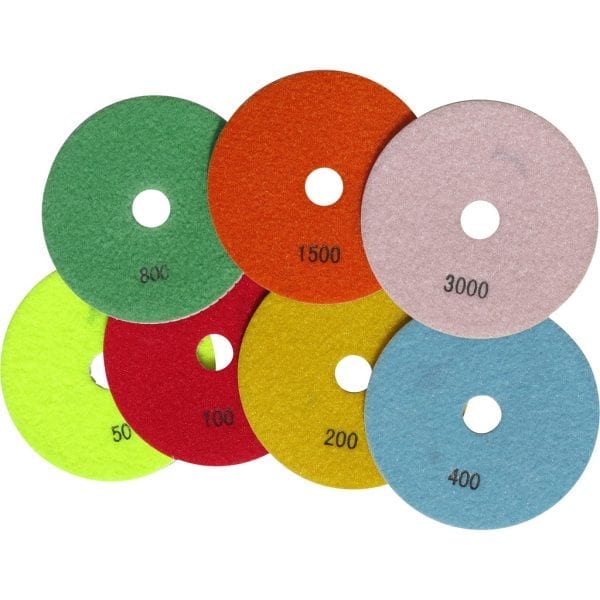
A very coarse metal bond cup wheel removes a great deal of material very fast. That’s its job. But it leaves an uneven, gouged surface suitable only for sidewalks. Most often a coarse resin bond disc (often 50 grit) is used to flatten the surface and remove the gouges from the cup wheel. Next a 100 grit disc further refines the surface, removing the visible scratches left from the 50 grit. And finally the 200 grit does the same thing. In fact each finer grit simply refines the surface and removes the scratches left by the previous, next-coarser disc. This is true of the 100 grit, and it’s true of the 3000 grit disc.

But the 200 grit disc is special because it represents a point in the production stage in a concrete countertop where many things can happen. Grouting is performed after the surface is honed to a 200 grit finish. Chemical densifiers are applied to a 200 grit finish (if polishing is going to occur), and most importantly, nearly all coatings are applied to a 200 grit finish.

Grouting occurs at the 200 grit stage for a practical reason. Most 100 grit pads leave small tool marks (multiple crescent-shaped scratches) that are hard to see when the concrete is unfinished, but when filled with grout they often show up after sealing. This is not acceptable to clients. On the other hand, good quality 200 grit pads do leave minor swirl marks, but these are not deep enough to be filled with grout, so therefore don’t show after sealing. In addition, hardened grout is removed with a 200 grit pad. If grout was removed with a 100 grit pad, not only would the surface have 100 grit scratches in it, the coarser pad is too aggressive and will cut deeper into the concrete and expose more pinholes, requiring further grouting. A 400 grit pad may not be aggressive enough to efficiently remove the hardened grout in a reasonable amount of time, and the smoother finish may prevent a coating-type sealer from sticking (more on that later).

A concrete surface honed to a 200 grit finish is satin-smooth to the touch but looks nearly dead-flat in sheen. If the concrete is to be polished, densifiers are applied at the 200 grit stage (after grouting) so that the cement paste can be hardened and polished along with the sand and aggregate. Chemical densifiers (especially the popular lithium based ones) leave a micro-thin, hard, transparent deposit that helps to fill in the micro-texture left by the 200 grit pad. Generally polishing begins at the 400 grit stage, when very little material is removed. Having the surface already densified before polishing begins makes the process more efficient and results in a better looking surface.

Because a 200 grit surface has a very slight micro-profile, it’s perfect for applying coatings. Most coatings rely on a mechanical bond to adhere to the concrete. Very smooth surfaces don’t allow a good bond, so coatings are at risk of peeling. And nearly all coatings leave a thin film of material that completely obscures the smooth profile of a polished surface. Even if the coating would form a reliable bond it’s a complete waste of time to polish at all. You simply cannot tell the difference between concrete honed to 200 grit and concrete polished to 3000 grit after they have been sealed with a coating.

So remember, if you’re using a coating sealer, stop polishing at 200 grit. Going any further is a waste of time and could compromise the sealer’s adhesion.

Buffing roller marks in a topical concrete countertop sealer

One further question about the article “Deciding on a concrete countertop sealer in Grand Cayman” was:

“What did you do to buff the roller marks away?”

Ideally, here is how you prevent roller marks:

  • Put the finish down fast
  • Roll everything to the same film thickness (quickly)
  • Minimize the amount of overrolling and backrolling
  • Keep all areas rolled the same amount

In practice, you are almost always going to end up with a few marks.

There weren’t really any major physical roller marks, rather most of the roller “marks” were sheen variations. The sheen variations occurred because of areas that had been rolled more than others. Backrolling, drips, roller holidays and simply working around the columns necessitated going over areas more than once. Usually with matte finishes the sealer loses sheen more in areas that are over-rolled and that have a thinner film thickness.

For the few areas that had small bumps or minor roller texture, I first sanded with 400 grit sandpaper on a random orbit sander. To even the sheen a bit more I used a common green 3M scrubbing pad on the random orbit sander. This made the duller areas shinier and the shinier areas duller, evening out the sheen and obscuring the roller marks.

Another great question, Paul. Keep them coming!

Color enhancement in concrete countertop sealers

I recently got a question regarding my article “Deciding on an outdoor concrete countertop sealer in Grand Cayman“:

“You never mentioned if the ‘pop’ in color is the same as a dry vs. wet look. I’ve applied sealers and although they looked matte, they still made the concrete look darker than before sealer is applied. Will this method [Stonelok 2K] change color?”

When a sealer “pops” the color of the concrete, it’s making the color seem richer, darker and more vivid. This is similar to what water does when it wets out the surface of concrete. A dry piece of concrete often looks very light, dull and lifeless. But when you wet it with water or seal it with certain sealers, the concrete comes to life, the color is truer and more vivid. This is all because of the way the sealer (or water) helps visible light reflect off the concrete.

Dry concrete scatters a lot of white light, so most of the light shining on it is scattered. The result: the concrete looks pale and lifeless.

light reflection rough

Wet concrete, polished concrete and concrete sealed with certain sealers reflects more of the light as colored light (the color of the concrete) and has less white light scattering. That’s why the concrete looks richer and more colorful.

light reflection wet surface

“Wet-look” sealers are sealers that make the concrete look like it’s wet with water. They pop the color and are typically very glossy. Not all finishes that pop the color make the concrete glossy. But high gloss finishes give the “wettest” look because of the combination of gloss and low white light scatter.

All sealers will affect the depth of color somewhat, although some waterbased acrylic sealers do very little to deepen the color. In effect they are the opposite of wet look sealers. Though the surface might be shiny from the acrylic, the color of the concrete still looks pale as if it were dry and unsealed. Every sealer is different, so you have to test the sealer to see whether its effect on the concrete’s color depth is what you want.

Stonelok E3 is a water-based epoxy that is used as a primer under Stonelok 2K (a waterbased urethane). E3 pops the color and is glossy. It’s not used as a sealer because it scratches too easily. Its job is to pop the color and to enhance the bond between the concrete and 2K. Stonelok 2K (the extra low gloss version I used) still pops the color a little bit, but not nearly as much as E3 does. The small amount of pop was acceptable to me and my client. I did test the E3 on a sample and didn’t like how it looked. That’s why I didn’t use it.

Thanks for the question Paul, and I hope that helps.

(I also covered this topic in a recent article for Concrete Decor Magazine.)