Concrete countertops feature prominently in church in Casper, Wyoming

The architect of the new Highland Park Community Church facility in Casper, Wyoming was seeking a versatile, customizable countertop surface. He found it with concrete countertops.

Gary Berchenbriter, concrete countertop artisan and owner of GB Building & Design, had just 2 days to bid the very large project: 450 square feet of reception desk and water feature, two large fireplace hearths, coffee bar and security desk. The client used multiple looks ranging from swirls of color to exposed glass and metal. Gary was able to show examples and samples of all the various desired looks and won the job.

Logistics

After bidding in November 2009, casting concrete started in June 2010 and proceeded in stages until the final installation in December 2010. Gary accomplished all this with himself and two part-time helpers. He had to make very efficient use of his 2400 sq ft shop, and build an additional casting table to handle the job. “This project really forced me to think through my shop organization,” says Gary.

Swirls of GFRC Accent the Welcome Desk

The reception area and two hearths used a swirled look that was challenging to reproduce. Gary had first created this look using two different colors of GFRC mist coat hand swirled in the forms. Consistency of the mix was an important factor in recreating this look, and Gary found that later he had to swirl the two colors in a bucket and then pour them into the forms. Whatever the technique, the outcome was striking.

Gary Berchenbriter water feature

Water feature behind the welcome desk

Gary Berchenbriter welcome desk

The welcome desk

Concrete Ties Together the Design in the Coffee Bar

For the coffee bar area, the architect used the concrete bartop to tie together the looks of the corrugated steel and red accent walls. Gary placed galvanized wire and recycled red glass in the forms, then poured GFRC mist coat over it, then placed the backer coat.

Some voids developed around the galvanized wire as the concrete cured, so Gary filled them in with a darker charcoal gray grout that further accented the embedments.

Gary Berchenbriter coffee bar closeup

Closeup of steel and glass embedments in coffee bar

Gary Berchenbriter coffee bar top

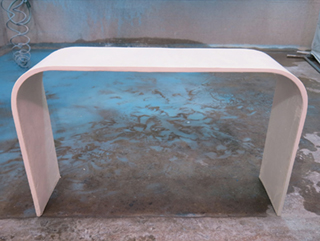
Curved bartop for coffee shop

Fireplace Hearths Serve as Gathering Places

Two massive fireplace hearths 18 feet wide and 21 feet wide are large enough for congregation members to gather around the fire. The hearths also used the swirled GFRC technique.

Gary Berchenbriter hearth1a

Gary Berchenbriter hearth2a

Security Desk Challenges

“I was most proud of the security desk because we were able to fit the pieces in a very challenging configuration,” Gary states. Three steel columns pierce the desk, at multiple angles and within curved countertop sections. Even the architect could not figure out how to connect the pieces, and left it up to Gary’s judgment and skill.

Gary Berchenbriter security desk

A Successful Project and a Versatile Surface

The sizes, shapes and colors possible with concrete, combined with the skill of a true concrete countertop artisan, made this a successful project. Congratulations Gary! You’re a great success story and an inspiration to other concrete countertop pros!

You can succeed too!Become a CCI student

Churches, restaurants and businesses should take note that concrete can deliver for desks, bartops, water features and fireplace hearths as well as many other functional and beautiful uses such as bathroom countertops and stair treads.

GB Building & Design offers concrete countertops and elements in Casper, Wyoming and around the country and can be reached at gberchen@gbcountertops.com or 307-262-6569. Visit Gary’s website at www.gbcountertops.com.

Concrete countertop mixers: How to decide on size, power and drum

In a previous post, I discussed the basic types of precast concrete countertop mixers: drum, mortar and vertical shaft. This post explains how to determine size, power source and drum style once you’ve selected the type of mixer.

Size of Mixer

What size mixer you need depends on how much concrete you plan on making at one time. A lot depends on the concrete consistency (fluid versus stiff) and how many people are involved in the process. Other factors include price, storage space and typical batch size.

The smallest mixers available can generally make about 200 pounds of “ordinary” concrete or concrete countertop concrete that has the consistency and makeup similar to conventional concrete. These small mixers are inexpensive and fairly portable. Two hundred pounds of concrete is just about 1-1/3 cubic feet of concrete; at 1-1/2” thick, that amount of concrete makes around 10.5 square feet of countertops.

The largest mixers top out at 12 cubic feet, and can make 1100 pounds, or 7-1/3 cubic feet of concrete in a single batch. These monsters can cover about 58 square feet of countertop at once, which is roughly the size of an average kitchen countertop.

Generally, mixers in the 6 to 9 cubic foot range are what most people select. Within this size range, batch sizes ranging from under 300 pounds to almost 500 pounds are possible. When selecting a mixer size, it’s important to consider the smallest batch as well as the largest batch you’ll be making. Very large mixers may not be able to effectively mix the small batch of concrete that a single small bath vanity needs.

Small shops that have only a few people available during the mixing and casting process may prefer to make smaller, more manageable batches. They may not be able to handle a single, large batch of concrete before it loses workability, while a larger shop that has more hands available could easily and more rapidly deal with a large batch.

For a given drum size, less concrete can efficiently be mixed if the concrete is stiff, while more concrete can efficiently be mixed if the concrete is fluid. Generally speaking, a mixer can handle roughly ¼ to 1/3 of its stated volume when mixing stiff concrete, and about ½ or more of its stated volume when mixing fluid concrete. The type of mixer is also a significant factor here too; drum and vertical shaft mixers can make more concrete for a given drum size than a mortar mixer.

Gasoline or Electric?

Gasoline engines are the most common power source for larger, towable mixers. The benefits are that they are self-contained. No external power supply is needed, so they are not dependent on the job site conditions. The downside is that they are loud, hot, require gasoline, and occasional maintenance. The most significant downside is the exhaust. Gasoline powered mixers should never be used inside, since the engine exhaust can be deadly due to carbon monoxide and carbon dioxide buildup.

Electric motors are much more common on smaller, stationary mixers, but are often available as optional power sources on large, towable mixers. Motors come in a variety of voltage and horsepower ratings. Typically smaller mixers use 110 volt, 1/3 to 1-1/2 horsepower (HP) motors, while larger mixers use 220 volt, 1 to 5 HP motors.

The benefit of 110 volts is that it’s available just about everywhere there is electric service. The downside is that 110 volt electricity draws twice the amperage as 220 volt electricity for the same horsepower motor. Greater amperage requires much larger gauge power cords and higher amperage rating on the outlet. Conversely, 220 volt electricity allows the use of higher horsepower motors, but 220 volt electrical outlets may not be readily available in all locations.

The benefits of electric motors is that there is often no, or very little, maintenance required. The motors are quiet, compact and may only add a few percent more to the purchase price. And they can be used inside.

The disadvantage is that for larger mixers, electric motors are options that need to be ordered; few if any floor models come with electric motors. And some jobsites may not have the power supply required for the mixer.

Electric motors are more efficient and provide more torque than gasoline engines. For an extreme example, a large drum-style mixer capable of mixing about 7.5 cubic feet (or 1100 lbs) of concrete requires only a 2 HP electric motor, but needs a 10 to 11 HP gasoline engine to do the same job. A similar sized vertical shaft mixer would need a 5 HP electric or a 9 HP gasoline engine to power it.

Steel or Plastic Drum?

Steel drums are the most common material and are therefore available in a wider range of mixer sizes and styles than plastic drums are. Steel drums, initially painted, epoxy, or powder coated, eventually wear down to bare metal, which can rust if they are stored wet.

Plastic drums (usually called “poly drums”) don’t corrode, but metal is far less abrasion prone than plastic. A steel drum that’s been kept spotlessly clean may last much longer than a plastic drum, but that depends on the concrete being mixed.

Lastly, bare steel drums, particularly in mortar mixers, can cause “mixer burn”, a phenomenon very similar to concrete that’s burned by a trowel. Essentially, light colored concrete that is very stiff will scrub steel off the drum as its mixing. White concrete that gets burned turns out light gray. Fluid mixes aren’t susceptible because there’s far less scrubbing that occurs.

Steel drum mixer

A steel drum

Poly drum mixer

A plastic (poly) drum

The best mixer for concrete countertops

For precast concrete countertops, your mixer is one of the biggest investments you will make at around $2000 and up, so buying just what you need, and not more than you need, is very important.

There are three basic types of concrete mixers available:

  • drum mixer
  • mortar mixer
  • vertical shaft mixer

All of these types come in a variety of sizes. Some can be run either by a gasoline engine or an electric motor. And some drum and many mortar mixers are available with either steel or plastic drums.

Drum Mixers

Drum mixers are what most people think of when they consider a mixer for making concrete. Drum mixers have a round drum with fins or vanes fixed to the inside of the drum. As the drum turns, the concrete is moved and lifted by the fins, and gravity causes the ingredients to tumble and to mix together.

Drum mixers are designed to mix relatively fluid concrete that has significant quantities of large aggregate in it; in other words, basic concrete of a consistency most people are used to and expect to encounter.

Thorough, effective and efficient mixing depends on the tumbling action of the mixer and on the concrete mixture’s physical characteristics to aid in the mixing process. The more fluid the mix, the more effective the mixing action. Typically stiff, very low slump, no slump and all-sand mixes are difficult to mix because they tend to stick to the walls of the drum and not tumble and churn. Often frequent hand scraping is necessary to remove stiff, clumped material that gets packed against the fins.

Mortar Mixers

Mortar mixer


Mortar mixers, sometimes called stucco mixers, have a horizontal shaft with paddles attached to the shaft. The drum of the mixer is semi-cylindrical and is stationary during mixing. The shaft and paddles rotate to mix the concrete in the drum.

Mortar mixers are designed primarily to mix all-sand mixes, typically used for making stucco and for making brick and block mortar. These mixes tend to be stiff, sticky and completely lack large aggregate. Thorough, effective and efficient mixing depends on the mixing action of the paddles and not so much on the concrete mixture’s physical characteristics. It is for this reason that mortar mixers tend to be more versatile because they can mix both highly fluid and very stiff concrete mixes.

Mortar mixers can usually handle concrete with up to 3/8” aggregate. The downside of mixing larger aggregate is that it significantly increases wear on the drum and on the paddle blades, which often use rubber strips that act like squeegees. Wear is reduced significantly with more fluid mixtures, and is significantly increased with stiff mixtures in mixers with plastic drums.

Vertical Shaft Mixers

Vertical shaft mixer

Vertical shaft mixers are similar to mortar mixers in that the wide, shallow, circular mixing pan is stationary. The drive shaft rises vertically through the center of the pan, and paddles and scrapers of various configurations move and mix the concrete.

Vertical shaft mixers are less common than the previous two types. However, they make up for this with increased mixing speed and efficiency. Vertical shaft mixers are capable of mixing most types of concrete, both stiff and fluid, but the discharge method may make stiff mixes more difficult to deal with.

With drum and mortar mixers, the entire drum is tilted to discharge the concrete. With vertical shaft mixers, the mixing pan is stationary and a relatively small door in the bottom of the pan is the discharge port. The concrete is discharged by opening the door and letting the mixing paddles scrape the concrete over the hole, letting gravity handle the rest.

It’s best to match the type of mixer to the type of concrete you plan on using when making concrete countertops. If you only work with fluid concrete, then a drum style mixer will meet your needs. However, if you work with all-sand mixes, or very stiff concrete, then a mortar or vertical shaft mixer may be a better choice.

Once you’ve determined the type of mixer, then select the size, power supply, and drum material based on your particular needs. I’ll discuss these factors in another post.

Concrete technology from early 1900s still applies today

Scientific American magazine has a section called “50, 100 & 150 Years Ago” that features blurbs from the magazine in each of those years. Here is a recent entry for March 1911:

“Concrete for Construction”

“About fifteen years ago serious attempts were made to combine steel and concrete by moulding one into the other in such a way that the resulting product would possess a high resistance not merely to compressive but to bending and tensional stresses. A vast amount of experimental work was done, out of which has sprung our modern reinforced concrete. Not only is concrete found to be available for practically every form of construction which hitherto has been built in brick and stone, but it has now invaded the field which was supposed to be peculiarly reserved for iron and steel.”

If you’ve seen my free video about reinforcing concrete countertops, you know exactly what these compressive, bending (flexural) and tensional stresses are! And you know that your concrete countertop construction methods are based on sound scientific principles. What’s surprising is how recently reinforced concrete was invented, seeing as concrete has been used since Roman times.

Making a GFRC concrete monolith

When you use GFRC to create concrete elements, making intricate designs is easy, but there are a few tricks to keep in mind, and it does require meticulous attention to detail.

I made what I call “the monolith” for our trade show booth. It’s really a self-standing concrete sign. This is a great product for businesses – you can offer a vertical, 3-dimensional concrete element that is also extremely functional.

The photo series below shows the basic steps in creating the monolith using GFRC. This monolith could have been created using wet cast techniques, but I would have needed a two-sided mold, and vibration could have moved the knockouts inside the mold.

I printed out letters on paper, glued the paper to insulation foam of the desired thickness, then cut out the letters with a scroll saw. I did the same with my logo. This took a lot of time. Alternatively, you could have a sign company create plastic letters and logo based on an electronic file you send them.

Cutting foam letters

I built the mold from melamine and glued in the foam letters. To create a recess, I used a strip of plastic with orange vinyl tape wrapped around it to create a smooth surface. I also used pieces of plate glass. In the photo below, Brad and I are pulling away the excess silicone caulk.

Pulling silicone

After spraying the mist coat, I had to use a brush to get into every tiny nook and cranny. This was very important to ensure a clean, crisp shape that picked up all the details of the lettering.

Packing mist coat

Picking out the foam from the finished piece was very tedious!

Removing foam

I added LED strips to the back of the plate glass pieces. Note also the four buttresses to create strength, like an airplane wing. The buttresses are foam wedges covered with backer coat.

Adding wiring

The finished monolith/sign. (There is also a river of glass in the base. How to create that is another topic.)

Finished monolith

The right way to build forms for concrete countertops

There is no one right way! The only requirements for concrete countertop forms are that they be dimensionally correct and made out of materials that will not warp (unless you are using dynamic fabric forming, but that’s another topic).

That said, there are two basic methods to forming, depending on whether you want an as-cast finish (“pop a perfect slab”) or you plan to grind to expose aggregate or create a polished finish (“grind and grout”).

If you want to pop a perfect slab, the casting surface must be absolutely perfect, because every little bump, scratch or spot will show up in the cast concrete. Very fluid mixes that can be vibrated to reduce surface pinholes need to be used with this method. These mixes are highly liquid and require watertight forms. You cannot use form release agents in your forms.

I long ago gave up on the pop a perfect slab method. It is simply too difficult to get a perfect, blemish-free, pinhole-free surface on a consistent basis. And, creating perfect, watertight forms is a lot of work. You end up forming and casting multiple times trying to get a perfect finish. I would rather spend time at the end grinding and grouting. I also feel that this is a more true to concrete look. Why hide the sand grains? Plus, the fine cement skin left on in the pop a perfect slab method is extremely fragile and hides tiny pinholes just below the surface. If that skin is damaged, it is impossible to repair.

For the grind and grout method that I prefer, the forms still need to be dimensionally perfect and smooth. But, there is a much wider variety of forming materials you can use and a wider variety of looks you can create.

For flat countertop slabs, I use strips of melamine and steel angle iron on a steel-topped casting table. The melamine is glued down with Power Grab, and the angle iron is clamped onto the edge of the table. Cresset’s Crete-Lease 880 VOC is the form release agent.
Forming with steel

For sink and faucet knockouts, I use blue insulation foam cut with a jigsaw or router and smoothed with a disk sander. There is no need to tape the edges of this foam.
Smoothing foam

I also use a router to cut the foam using a Masonite template as a guide.

With these simple to assemble materials, creating an accurate, stable form is quick and easy.

A concrete countertop success story: Dave Banko of Counterpart LLC

Dave Banko, the founder and owner of Counterpart LLC in Raleigh, NC, began his career after graduating with honors from the NCSU School of Design in 1990 with a degree in Industrial Design. From there, he quickly went on to form his own company, Point Concepts Designs, Inc. with his partner and good friend Dan Schwab. After 14 years of running a very successful Exhibit Design company with Dan, Dave felt a need to fulfill some personal goals of his own. So, in 2005, Dave sold his interest in Point Concepts Design to pursue his dreams. He then received his General Contractors License in January of 2007 and began renovating properties. In that process, Dave became acutely aware of the need for fresh, new choices in countertop surfaces that provided an architectural element.

Banko stumbled upon concrete and was stunned at the myriad of options with the material. In April 2007, he attended training at The Concrete Countertop Institute and was able get started immediately supplying his customers with custom designed and fabricated concrete solutions. “The class taught me everything I needed to know in order to do it myself. Jeff started with basic instruction and worked the way up from there, teaching how to do each step and making sure we understood what’s in the mix and why. I was able to leave the class and be up and running in a very short period of time with a minimal learning curve.”

One of Dave’s signature projects is the Tyler’s Taproom bartop. This bartop, while relatively simple in terms of being a flat slab with a simple edge, represents the customizability of concrete and its utility in a commercial setting. The custom bright red works with the overall restaurant design, and the embedded steel and black concrete logos offer a stunning customization not possible with other countertop surfaces.

Dave Banko Counterpart Raleigh bartop

Congratulations, Dave, for many successful projects and for representing the quality and utility of concrete so well.

Dave Banko Counterpart Raleigh kitchen  Dave Banko Counterpart Raleigh kitchen2


Dave Banko Counterpart Raleigh Ramp Sink  Dave Banko Counterpart Raleigh Sink